Wearable AI Revolution: Your Future Personal Assistant on Your Wrist & Beyond

For the better part of two decades, the smartphone has been our digital everything—our navigator, our camera, our window to the world. But look around. Heads are perpetually bowed, our attention held captive by glowing rectangles. We’ve reached peak screen. A new paradigm is quietly emerging, one that promises to untether us from our phones and weave technology seamlessly into the fabric of our lives. Welcome to the wearable AI revolution.
This isn’t just about smarter smartwatches that count your steps. This is about the dawn of ambient computing, where intelligence is all around us, ready to assist without demanding our full attention. We’re talking about AI personal assistant devices that live on your wrist, your finger, your lapel, or even in your ear, offering proactive AI assistance before you even think to ask.
This comprehensive guide explores the exciting landscape of intelligent wearables. We’ll dive into the cutting-edge devices redefining the future of wearable tech, unpack the powerful on-device AI that makes them tick, and explore how this shift will fundamentally change our daily routines, our productivity, and the very nature of human-computer interaction. Get ready to meet your next personal assistant.
Beyond the Smartwatch: The Dawn of Truly Intelligent Wearables
The first wave of wearables, dominated by smartwatches and fitness trackers, was largely reactive. They needed to be tapped, swiped, and constantly synced with a phone. They were accessories to our primary computer, the smartphone. The new generation of next-gen smart devices is fundamentally different.
The goal is a seamless AI integration that makes technology feel less like a tool you operate and more like a partner that collaborates with you. This shift is powered by advancements in miniaturization and, most importantly, the ability to run powerful AI models directly on these tiny devices. This is the world of on-device AI wearables, where latency is minimal and privacy is paramount.
The core promise is a move towards hands-free AI. Instead of pulling out your phone to find information, you’ll simply ask a question. Instead of typing a reminder, you’ll speak it into existence. These voice AI wearables are designed to augment your reality, not replace it, enabling a more present and heads-up existence. This evolution is as significant as the jump from desktop to mobile, representing a new frontier in personalized intelligence. [Related: What is GPT-4o? OpenAI’s New Multimodal AI Explained]
The New Form Factors: Meet Your AI Companion Devices
The wearable AI revolution isn’t a one-size-fits-all phenomenon. A vibrant ecosystem of diverse form factors is emerging, each tailored to different needs and contexts. These are the AI companion devices leading the charge.
The Smart Ring AI: Discreet Power on Your Finger
Perhaps the most subtle of the new wearables, the smart ring is a marvel of miniaturization. Devices like the Oura Ring and Ultrahuman Ring have already proven their value in the wearable health AI space, tracking sleep, activity, and readiness scores with incredible precision. But their potential extends far beyond wellness.

The next wave of smart ring AI aims to make these devices true personal assistants. Imagine tapping your ring to authorize a payment, receiving a subtle haptic buzz for an urgent notification, or whispering a command to your AI without anyone noticing. As a form of smart jewelry AI, these discreet AI devices blend seamlessly into your life, offering powerful functionality without screaming “tech.” They are the epitome of AI fashion tech, where style meets substance.
AI Glasses: Seeing the World Through a Layer of Intelligence
The idea of smart glasses has been around for years, but early attempts were often clunky and socially awkward. Today, thanks to more sophisticated tech and design, AI glasses are making a serious comeback. Devices like the Meta Ray-Ban Smart Glasses and the Brilliant Labs Frame look and feel like regular eyewear but pack a powerful AI punch.
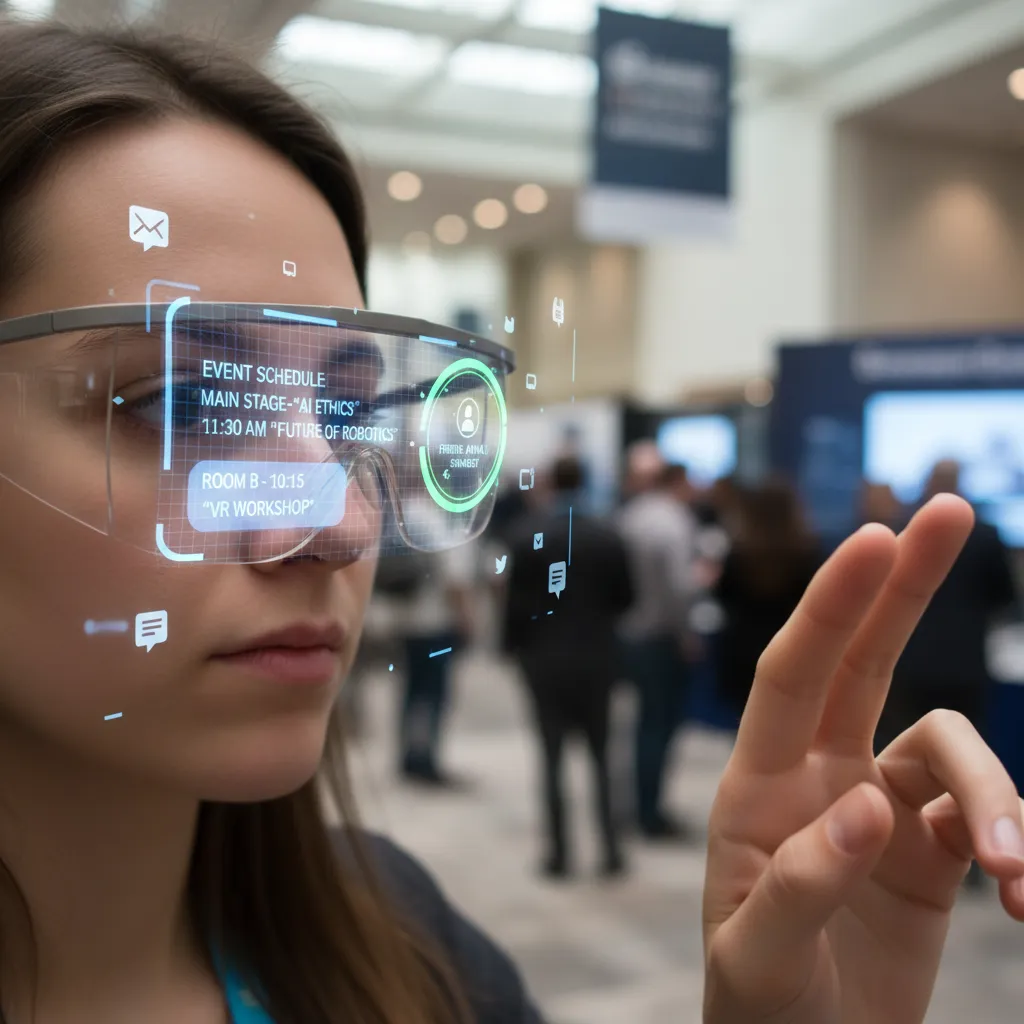
These AI augmented reality wearables can overlay useful, context-aware information directly onto your field of view.
Potential use cases include:
- Real-time Translation: See subtitles for a foreign language conversation as it happens.
- Visual Search: Look at a plant or a landmark and ask your AI what it is.
- Step-by-Step Navigation: Get directions as a subtle overlay, so you never have to look down at your phone again.
- Information Recall: Your AI could remind you of the name of the person you’re talking to at a conference.
This technology represents a profound shift in how we access information, moving from “search” to “discovery” and embedding everyday AI directly into our perception of the world.
AI Pins & Pendants: The “Un-Phone” Experience
For those looking to break free from the screen entirely, a new category of ambient devices is emerging, led by products like the Humane Ai Pin. These are designed to be true AI personal assistant devices from the ground up.
Clipped to your clothing, these devices rely almost entirely on voice commands and gestures. The core concept is to provide access to the power of AI without the distraction of a traditional app-based interface. You can make calls, send messages, get summaries of your emails, and ask complex questions, all through natural conversation. While the first generation of these devices has faced challenges, they represent a bold vision for the future—a future where your primary connection to the digital world is a conversation, not a screen. [Related: The Psychological Impact of Hyper-Realistic AI Content]
Hearables and Smart Jewelry AI: The Future is in Your Ear
Your ears are a direct and private channel for audio information, making “hearables” one of the most promising frontiers for wearable AI. We’re not just talking about earbuds for listening to music. The next generation of hearables are powerful AI productivity gadgets.
Imagine earbuds that can:
- Provide real-time language translation during a meeting.
- Offer AI personal coaching during a workout, correcting your form based on your movements.
- Act as a discreet audio prompter during a presentation.
- Filter out background noise while enhancing the voice of the person you’re speaking with.
This is where the line between accessory and assistant blurs, turning a simple earbud into a powerful tool for AI driven personal growth and professional enhancement.

The Engine Under the Hood: How Wearable AI Actually Works
The magic of these futuristic devices isn’t just in their small size; it’s in the sophisticated technology they contain. Several key innovations are coming together to make this revolution possible.
On-Device AI vs. Cloud AI: The Privacy & Speed Equation
Traditionally, complex AI tasks required sending data to a powerful server in the cloud for processing. This creates a delay (latency) and raises significant privacy concerns. The game-changer for wearables is the rise of on-device AI.
New, highly efficient AI chips and optimized software allow many tasks to be handled directly on the wearable itself. This means your personal data stays with you, and the response from your AI assistant is nearly instantaneous. This local processing is crucial for creating a feeling of personalized intelligence that is both fast and secure, a core tenet of the on-device AI wearables movement.
Context-Aware AI: Your Proactive Personal Assistant
The true power of a personalized AI assistant isn’t just reacting to your commands; it’s about anticipating your needs. This is the domain of context-aware AI.
By securely integrating with your calendar, location, biometric data, and even your past behavior, your wearable AI can understand your situation and provide proactive AI assistance.
- It knows you have a flight, checks the traffic and your gate number, and tells you when to leave for the airport.
- It detects a spike in your heart rate and stress levels during a busy workday and suggests a 5-minute breathing exercise.
- It recognizes that you’re in a grocery store and reminds you of the milk you forgot to add to your shopping list.
This level of intuitive support is what will elevate these devices from novel gadgets to indispensable life companions. [Related: Meta Llama 3: The Ultimate Guide to the New Open-Source AI Model]
Reshaping Our World: The Real-World Impact of Wearable AI
This technological shift isn’t just about convenience; it’s about fundamentally enhancing human capability across all aspects of life. The wearable technology trends we’re seeing today are just the beginning of a massive transformation.
The Future of Work AI: Your On-the-Go Productivity Partner
In the professional world, wearable AI will become a secret weapon for productivity. The future of work AI is one where information and assistance are instantly accessible, freeing up mental bandwidth for more strategic thinking.
Imagine a surgeon with AI glasses displaying a patient’s vital signs in their peripheral vision, or an engineer seeing a 3D schematic overlaid on a piece of machinery. For knowledge workers, a discreet earbud could transcribe meetings and generate summaries automatically. These AI productivity gadgets will reduce friction and empower professionals to perform at their peak, creating a more efficient and intelligent workforce.
AI-Driven Personal Growth and Coaching
Wearable AI is poised to become the ultimate tool for self-improvement. The potential for AI driven personal growth is immense, with devices acting as a round-the-clock coach and mentor.
- Fitness: An AI personal coaching system could analyze your running form in real-time and provide audio feedback to prevent injury.
- Public Speaking: AI glasses could monitor audience engagement and offer subtle prompts to help you refine your delivery.
- Mindfulness: A smart ring could track your stress indicators and guide you through personalized meditation exercises when you need them most.
By providing objective, data-driven feedback, these devices can help us build better habits and unlock our full potential.
Revolutionizing Health and Wellness
The most immediate and profound impact of wearable AI is already being felt in health and wellness. Going far beyond simple fitness tracking, wearable health AI is becoming a critical tool for preventative care and chronic disease management. Continuous monitoring of biomarkers like heart rate variability, blood oxygen levels, and body temperature can provide early warnings for potential health issues long before symptoms appear. This constant stream of AI in daily life health data empowers individuals and their doctors to make more informed decisions, shifting the focus from treatment to prevention.
The Hurdles and Headwinds: Challenges on the Path to Mass Adoption
Despite the incredible promise, the road to a fully-realized ambient computing future is not without obstacles. Several key challenges must be addressed for wearable AI to achieve mainstream success.
- The Battery Life Dilemma: Packing powerful processors and sensors into tiny devices puts an immense strain on batteries. All-day (or multi-day) battery life is non-negotiable for a device meant to be worn constantly.
- Privacy and Data Security: These devices will collect an unprecedented amount of personal data. Earning user trust through transparent policies and robust on-device security will be paramount.
- The Social Acceptance Factor: The “Glasshole” effect that plagued early smart glasses is a real concern. Devices must be stylish, discreet, and socially considerate to avoid creating friction.
- Accuracy and Reliability: An AI assistant that frequently misunderstands commands or provides incorrect information (“hallucinates”) is worse than no assistant at all. Reliability is key to building dependence and trust. [Related: Google AI Overviews: SEO Killer or the New Frontier?]
Conclusion: The Ambient Computing Future is Closer Than You Think
We are at the very beginning of a seismic shift in personal technology. The move away from the screen-centric world of the smartphone towards a more integrated, intuitive, and human-centric model of ambient computing is already underway. The wearable AI devices we see today—the smart rings, the AI glasses, the hearables—are the pioneers of this new frontier.
They represent a future where technology adapts to us, not the other way around. A future of proactive AI assistance that helps us be more productive, healthier, and more present in our own lives. The journey will have its challenges, but the destination is a world with more seamless, personalized, and powerful human-computer interaction. The revolution won’t be televised; it will be worn.
What wearable AI device are you most excited to try? Share your thoughts and join the conversation below!
Frequently Asked Questions (FAQs)
Q1. What exactly is wearable AI?
Wearable AI refers to electronic devices that can be worn as accessories, embedded in clothing, or even implanted in the body, which incorporate artificial intelligence to provide intelligent assistance. Unlike traditional wearables, they use AI for proactive, context-aware functions, such as real-time translation, health monitoring, and personalized coaching, often operating hands-free through voice commands.
Q2. How is wearable AI different from a smartwatch?
While a smartwatch is a type of wearable, most current models act as companions to a smartphone, primarily for notifications and basic apps. Wearable AI devices are designed to be more autonomous AI personal assistant devices. They often feature more advanced on-device AI, focusing on proactive AI assistance and natural language interaction rather than a screen-based interface.
Q3. What are some examples of AI wearable devices?
Key examples in the market today include smart ring AI like the Oura Ring for health tracking, AI glasses such as the Meta Ray-Ban Smart Glasses for hands-free photos and AI interaction, and dedicated AI companion devices like the Humane Ai Pin, which is a screenless, voice-first assistant.
Q4. What are the main benefits of using AI wearables?
The primary benefits include convenience, efficiency, and personalization. They offer hands-free AI access to information, enabling users to stay present and engaged in their environment. They also provide powerful tools for wearable health AI monitoring, AI personal coaching for fitness and skills, and increased productivity through proactive AI assistance.
Q5. What are the privacy concerns with wearable AI?
Privacy is a significant concern as these devices can collect vast amounts of sensitive personal data, including conversations, location, and biometric information. Key challenges include ensuring secure data storage, providing user control over what data is collected, and being transparent about how that data is used, especially for cloud-connected devices.
Q6. How will wearable AI change the future of work?
In the future of work, AI wearables are expected to become powerful AI productivity gadgets. They can provide hands-free access to information for frontline workers, offer real-time language translation in international meetings, automatically transcribe and summarize discussions, and streamline workflows, allowing employees to focus on higher-value tasks.
Q7. Is wearable AI the same as ambient computing?
Wearable AI is a key component and enabler of ambient computing. Ambient computing is the broader concept where intelligence and computing power are embedded invisibly into the environment around us. Wearable AI devices are the personal, portable nodes of this larger network, acting as the primary interface between the user and the ambient intelligence.