Beyond the Screen: How Wearable AI Will Augment Human Capabilities

Introduction
For the past decade, wearable technology has been synonymous with fitness trackers counting our steps and smartwatches buzzing with notifications. While useful, these devices have largely been passive observers—data collectors that live on the periphery of our lives. But we are standing on the precipice of a monumental shift. The convergence of artificial intelligence and ever-shrinking hardware is giving rise to a new era of intelligent wearables future, one that moves beyond simple tracking and into active augmentation.
This is the dawn of human augmentation technology—a field dedicated to enhancing our innate abilities through technology. We’re not just talking about another app on a watch; we’re talking about a future where technology is woven into the very fabric of our existence, amplifying our strength, sharpening our minds, and even expanding our senses.
In this deep dive, we’ll explore the incredible landscape of wearable AI. You’ll learn how these augmented intelligence devices are set to redefine what it means to be human, from the benefits of AI wearables in daily life to the complex ethical questions we must confront. Get ready to look beyond the screen and into a future where your own capabilities are the next user interface.
The Dawn of Augmented Intelligence: More Than Just Gadgets
The evolution of personal technology has always been about closing the gap between human intent and digital action. We went from clunky desktops to laptops, then to smartphones that put the internet in our pockets. The next logical step in this journey is dissolving the interface altogether. The human machine interface future is one where technology becomes an intuitive and invisible extension of ourselves.
Next gen wearable tech is the engine of this transformation. Unlike your smartphone, which you consciously pick up and use, these devices are designed for constant, ambient interaction. They will learn your patterns, anticipate your needs, and offer assistance without you ever having to ask.
This isn’t about replacing human intelligence but enhancing it—a concept known as “augmented intelligence.” Instead of outsourcing our thinking to a machine, we’re creating a symbiotic partnership. This will fundamentally change the AI in daily life future, moving AI from a tool we use to a partner we collaborate with, moment by moment.
Amplifying Physical Prowess: From Rehabilitation to Superhuman Feats
One of the most immediate and tangible impacts of wearable AI will be on our physical bodies. This technology promises not only to restore lost function but to elevate our natural capabilities to new heights.
The Revolution in Assistive Technology
For millions of people, human augmentation technology is not a futuristic luxury but a present-day necessity. AI is breathing new life into assistive devices, making them smarter, more intuitive, and deeply personalized.
-
Smart Prosthetics AI: Modern prosthetic limbs are evolving from static tools into dynamic extensions of the body. Powered by AI and advanced wearable sensors, they can interpret nerve signals from the user’s muscles, allowing for fluid, natural movement. These devices learn and adapt, improving their responsiveness over time and enabling users to perform tasks with unprecedented dexterity.
-
AI Exoskeleton Future: Powered exoskeletons are no longer confined to sci-fi films. In manufacturing and logistics, they help workers lift heavy loads with minimal strain, reducing injuries and fatigue. In healthcare, they are a cornerstone of rehabilitation, helping patients with spinal cord injuries or stroke regain mobility. The AI exoskeleton future points to lighter, more powerful suits that could become a common mobility aid. Related: AI Medical Marvel: Early Disease Detection and Personalized Treatment
-
AI Assisted Living Devices: The aging global population presents a unique set of challenges. Wearable AI is stepping up with solutions. Smart sensors can monitor for falls, track medication adherence, and provide gentle reminders. These assistive AI technology trends are focused on promoting independence and safety for the elderly, offering peace of mind to both users and their families.
Unlocking Peak Human Performance
Beyond restoration, wearable AI is pushing the boundaries of what healthy bodies can achieve. The world of sports provides a clear window into the future of human performance enhancement AI.

Athletes are already using advanced wearable sensors embedded in clothing or worn on the body to track a flood of biometric data—heart rate variability, muscle oxygenation, lactate thresholds, and movement patterns. AI algorithms then analyze this data to provide real-time feedback, optimize training regimens, predict injury risk, and suggest tactical adjustments during a game.
This same technology will trickle down to the everyday consumer, creating a new paradigm of personal fitness. Imagine a wearable that doesn’t just count your reps but analyzes your form and tells you how to improve, acting as a hyper-personalized coach. This is a key part of the benefits of wearable AI—making elite-level insights accessible to everyone. While the notion of AI for superhuman abilities might seem far-fetched, in the context of optimizing health and performance, it’s already happening. Related: The AI Fitness Revolution: Hyper-Personalized Workouts and Coaches
Cognitive Enhancement: A Second Brain on Your Sleeve
Perhaps the most profound augmentation will be the one that enhances our minds. Wearable AI is poised to become an external cognitive layer, helping us process information, learn faster, and navigate an increasingly complex world.
Real-Time Information and Productivity Boosts
The primary goal of cognitive enhancement AI is to provide the right information at the right time, without friction. This is where devices like smart glasses and their successors will shine.

Imagine walking into a business meeting and seeing the names and titles of attendees discreetly displayed in your field of vision. Or a surgeon viewing a patient’s vital signs and 3D medical scans overlaid directly onto their body during an operation. This is the promise of smart contact lenses AI and advanced augmented reality glasses.
The productivity with wearable AI is immense. Key applications include:
- Instant Language Translation: Have a seamless conversation with someone in another language, with subtitles appearing in your view.
- Contextual Reminders: Your wearable reminds you to grab milk not when you leave the house, but when you physically walk past the grocery store.
- On-the-Fly Fact-Checking: Settle a debate or verify information with a simple voice query, with the answer displayed discreetly.
- Step-by-Step Instructions: Whether you’re repairing a car engine or cooking a complex recipe, visual prompts can guide you through the process. Related: Apple Intelligence: Your Guide to iOS 18’s New AI Features
The Ultimate Personalized Assistant
True personal AI augmentation goes beyond simple information retrieval. The future lies in personalized AI augmentation, where your wearable AI becomes a true digital twin. It will understand your goals, preferences, and communication style. It could help you draft emails in your unique voice, summarize lengthy reports based on what it knows you find important, and even gently nudge you towards healthier habits. This proactive, deeply integrated assistance will feel less like using a tool and more like having a trusted advisor with you at all times.
Expanding the Senses: Perceiving the World in New Ways
Our five senses define our reality. But what if technology could expand that reality? AI for sensory enhancement is an emerging frontier in human augmentation that aims to do just that—restoring lost senses and even granting new ones.
Hearing Beyond the Limits
The humble hearing aid is undergoing a radical AI-powered transformation. AI hearing aids advancements are leading to “hearables” that offer superhuman auditory capabilities. These devices can:
- Isolate Voices: Using machine learning, they can identify and amplify a specific person’s voice in a loud, crowded room, effectively filtering out all background noise.
- Translate in Real-Time: Listen to a foreign language and hear the translation whispered directly in your ear.
- Protect Hearing: Automatically dampen dangerously loud sounds, like a passing siren or a jackhammer, to protect your ears from damage.
The Future of Vision and Touch
The same principles apply to our other senses. Smart contact lenses AI are in development with the potential to offer telescopic zoom, enhanced night vision, or the ability to see light in infrared or ultraviolet spectrums.
Further out, researchers are exploring bio-integrated AI tech like smart tattoos technology. These are ultra-thin, flexible electronic circuits that adhere to the skin like a temporary tattoo. Initially used for health monitoring AI wearables—tracking vitals like heart rate, hydration, and glucose levels without a bulky device—they could one day provide haptic feedback. Imagine feeling the direction to your destination through gentle vibrations on your skin, a new form of sensory input for navigation.
The Final Frontier: Direct Brain-Computer Interfaces (BCIs)
The most ambitious vision for the human machine interface future involves a direct connection to the brain. While still largely in the realm of research and clinical trials, brain computer interface wearables represent the ultimate form of augmentation.
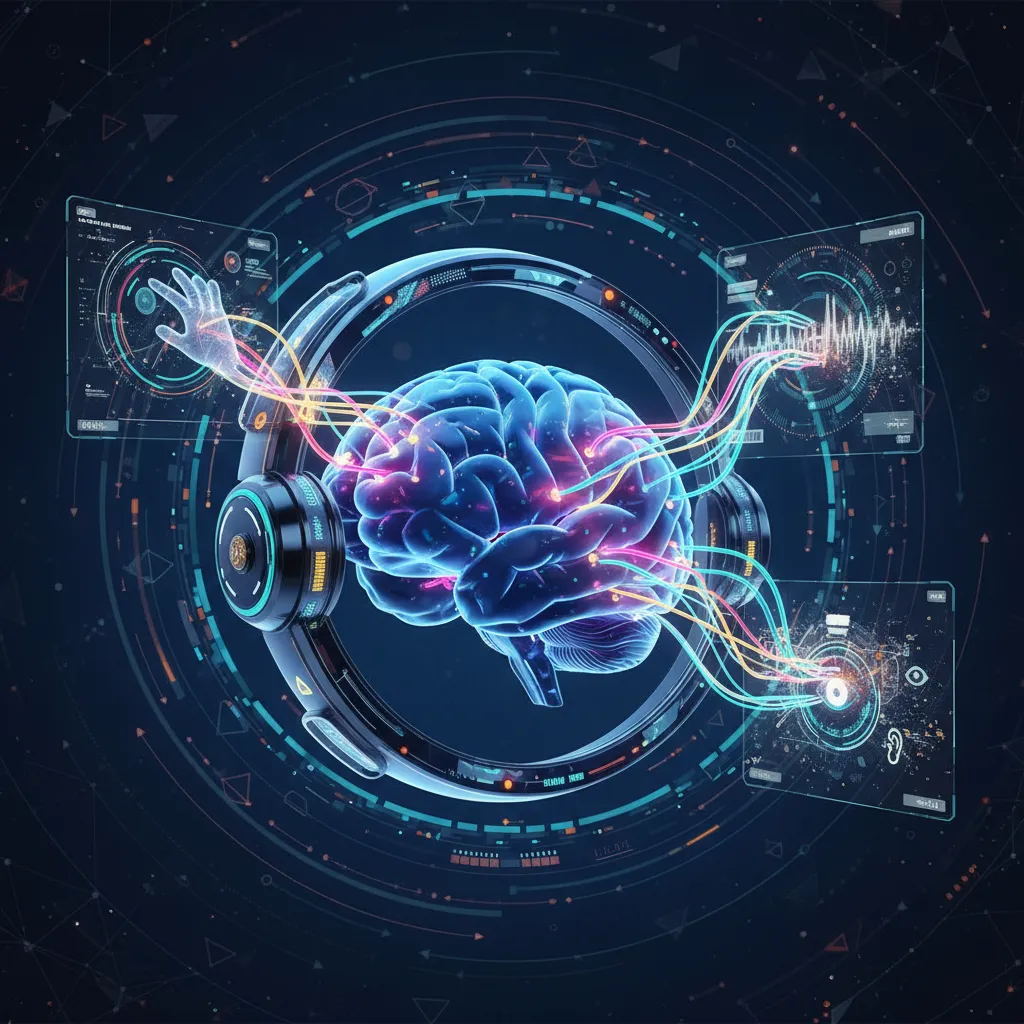
Non-invasive BCIs, often worn as a headset or headband, can read brainwave patterns (EEG signals) to allow users to control computers, drones, or smart home devices with their thoughts. This technology holds immense promise for individuals with severe paralysis, offering a new way to communicate and interact with the world.
Looking further into the future, the concept of the AI implants future raises both exciting and unsettling possibilities. While permanent, direct neural links could offer unparalleled bandwidth for thought-to-machine communication, they also bring us deep into the territory of the ethics of human augmentation.
The Double-Edged Sword: Ethics and Risks of Human Augmentation
No discussion of this powerful technology is complete without a sober look at its challenges. The path to our augmented future is paved with complex ethical questions that we must address proactively.
The Promise: Benefits of AI Wearables
Before diving into the risks, it’s crucial to summarize the immense positive potential. The core wearable AI benefits are clear:
- Health & Wellness: Continuous health monitoring AI wearables can lead to early disease detection and hyper-personalized healthcare.
- Accessibility: Assistive AI technology trends can grant greater independence and quality of life to people with disabilities.
- Productivity & Learning: We can process information more efficiently and learn new skills faster.
- Safety: Wearables can monitor our environment for dangers or alert emergency services after an accident.
The Peril: Risks and Ethical Dilemmas
With great power comes great responsibility. The risks of human augmentation are significant and require careful consideration:
- Privacy and Data Security: These devices will collect the most intimate data imaginable—our biometric signals, our location, what we see, and perhaps one day, our thoughts. Who owns this data? How will it be protected from hackers or misuse by corporations and governments?
- The Digital Divide 2.0: If these enhancements come at a high cost, we risk creating a two-tiered society of the “augmented” and the “un-augmented.” This could exacerbate existing social inequalities on a biological level.
- Autonomy and Over-Reliance: What happens when we begin to outsource our memory, navigation, or decision-making to an AI? Could our natural cognitive abilities atrophy? At what point does the AI’s “suggestion” become a command we can’t ignore?
- Authenticity and Identity: If a wearable AI is constantly shaping our thoughts and experiences, where does our authentic self end and the machine begin? The ethics of human augmentation forces us to ask fundamental questions about what it means to be human.
Navigating these challenges requires robust public discourse, thoughtful regulation, and a commitment to developing this future personal technology for the benefit of all humanity. Related: Claude 3.5 Sonnet vs. GPT-4o: The New AI King Showdown
A Day in the Life: The Future of AI in Daily Life (Circa 2035)
To make this tangible, let’s imagine a day with fully integrated wearable AI.
You wake up not to a blaring alarm, but to a gentle shift in your room’s lighting, timed perfectly to your sleep cycle by your health monitoring AI wearable. A quick glance at your smart contact lens display shows your sleep quality score and a summary of your day’s schedule.
During your commute, your AI hearing aid filters out traffic noise while allowing you to listen to a podcast. A subtle notification in your vision alerts you to an accident on your route and seamlessly suggests an alternative.
At work, your productivity with wearable AI is in full swing. It transcribes your meetings, highlights action items, and pulls up relevant data before you even think to ask for it.
In the evening, you visit your elderly parent. Your mind is at ease because you know their AI assisted living devices are monitoring their health and environment, ensuring their safety and independence. This is the integrated, helpful, and seamless AI in daily life future that this technology promises.

Conclusion: Embracing Our Augmented Future Responsibly
We are moving from a world of handheld devices to a future of integrated, body-worn intelligence. The journey of human augmentation technology is just beginning, but its trajectory is clear: it will enhance our bodies, sharpen our minds, and expand our senses in ways we are only starting to imagine.
From smart prosthetics AI that restores movement to cognitive enhancement AI that acts as a second brain, the intelligent wearables future promises a world of unprecedented capability and convenience.
However, we must walk this path with our eyes wide open. The profound ethics of human augmentation—issues of privacy, equity, and identity—must be at the forefront of the conversation. By embracing the potential while actively mitigating the risks, we can ensure that this next wave of future personal technology serves to elevate all of humanity, creating a future that is not just smarter, but also more compassionate and accessible for everyone.
FAQs
Q1. What is the goal of human augmentation?
The primary goal of human augmentation is to use technology to enhance human capabilities, whether physical, cognitive, or sensory. This can range from restoring a lost function, like with a prosthetic limb, to improving natural abilities, such as enhancing memory or concentration with a wearable device.
Q2. What are the benefits of wearable AI?
The key benefits of AI wearables include continuous health and fitness monitoring, increased productivity through real-time information access, enhanced safety features like fall detection, and greater accessibility for individuals with disabilities through smart assistive devices.
Q3. What is an example of a human augmentation device?
A great example is an advanced smart prosthetic AI limb. It uses sensors to read muscle signals, allowing the user to control it intuitively, almost like a natural limb. Other examples include AI-powered hearing aids that can isolate voices in a crowd and smart glasses that overlay digital information onto the real world.
Q4. What are the ethical concerns of human augmentation?
The main ethical concerns, or risks of human augmentation, include data privacy (who controls your biological data?), equity (will it create a gap between the enhanced and unenhanced?), and autonomy (will we become over-reliant on technology?). There are also philosophical questions about identity and what it means to be human.
Q5. Will AI be implanted in humans?
The AI implants future is a real area of research, primarily focused on medical applications like brain-computer interfaces to help paralyzed individuals communicate. While mainstream elective AI implants are still far in the future, the technology is advancing, making it a critical topic in the discussion around the ethics of human augmentation.
Q6. What is the future of wearable technology?
The future of wearable tech is moving beyond passive tracking towards active augmentation. Expect to see more bio-integrated AI tech, like smart tattoos and smart contact lenses. These next gen wearable tech devices will be less visible, more powerful, and deeply integrated into our daily lives to provide personalized, context-aware assistance.
Q7. How does AI enhance human capabilities?
AI enhances human capabilities by processing vast amounts of data in real-time to provide actionable insights. For example, it can analyze biometric data to optimize an athlete’s performance (human performance enhancement AI), filter ambient noise to improve hearing (AI for sensory enhancement), or provide instant information to aid memory and decision-making (cognitive enhancement AI).