Strategic AI Integration: Fueling Business Growth and Competitive Advantage

Introduction
Artificial Intelligence is no longer a futuristic buzzword whispered in Silicon Valley boardrooms; it’s the undeniable engine of modern business. From startups to global enterprises, companies are scrambling to adopt AI. But here’s the critical distinction that separates market leaders from the laggards: the difference between simply using AI tools and strategically integrating AI into the very fabric of the organization. A scattergun approach of adopting isolated AI productivity tools might yield minor efficiencies, but a cohesive AI business strategy is the key to unlocking transformative, AI driven growth and securing a lasting competitive advantage.
Many businesses stumble not because of the technology itself, but because they lack a clear vision. They chase trends without a roadmap, leading to wasted resources, disjointed systems, and a failure to realize the true potential of this powerful technology. This is where strategic AI integration comes in. It’s a holistic approach that aligns every AI initiative with core business objectives, ensuring that technology serves the strategy, not the other way around.
This comprehensive guide will serve as your blueprint for navigating the complexities of AI digital transformation. We’ll explore how to move beyond ad-hoc adoption to build a robust AI innovation strategy, detail a practical AI implementation guide, and tackle the common AI integration challenges head-on. By the end, you’ll understand how to leverage AI to not just optimize processes, but to fundamentally reshape your business for the future.
Beyond the Hype: Why a Strategic Approach to AI is Non-Negotiable
In the rush to embrace the latest AI technology trends 2024, it’s easy to fall into the trap of “AI for AI’s sake.” A marketing team might adopt a generative AI tool for copywriting, while the logistics team experiments with a separate platform for supply chain optimization. While both may be beneficial in isolation, they represent tactical wins, not strategic victories.
A strategic approach elevates the conversation from “What AI tools can we use?” to “What are our biggest business challenges, and how can AI be a core part of the solution?” This shift in mindset is fundamental. It ensures that investments in enterprise AI solutions are purposeful, measurable, and cumulative.
Strategic AI integration means:
- Alignment: Every AI project is directly linked to a key performance indicator (KPI), whether it’s increasing market share, improving customer retention, or reducing operational costs.
- Scalability: The architecture and data governance are designed from the ground up for scaling AI in business, preventing the creation of isolated data silos and technological dead-ends.
- Cohesion: AI systems can communicate and share insights across departments, creating a unified intelligence layer that enhances AI decision making throughout the entire organization.
- Sustainability: The strategy accounts for the long-term AI workforce impact, focusing on upskilling employees and fostering a culture of data-driven innovation.
Without this strategic foundation, even the most advanced AI tools become little more than expensive gadgets. With it, they become powerful catalysts for sustainable growth and market leadership.
The Pillars of AI-Driven Growth: Core Benefits for Your Business
When implemented strategically, AI becomes a multi-faceted engine for value creation. It touches every part of the business, transforming core functions and unlocking new opportunities. Here are the four foundational pillars where AI delivers the most significant impact.
Revolutionizing Operations with AI Automation
At its core, AI is a powerful tool for automating repetitive, rule-based tasks, but its capabilities extend far beyond simple robotics. Modern AI automation benefits include optimizing complex systems, predicting maintenance needs, and streamlining entire workflows. By handing over manual processes to intelligent systems, you free up your human talent to focus on high-value activities like strategy, creativity, and customer relationships.

Consider manufacturing, where AI algorithms can analyze production line data in real-time to predict equipment failures before they happen, minimizing downtime. In logistics, AI supply chain optimization can reroute shipments based on weather patterns, traffic data, and port congestion, saving millions in fuel and time. These aren’t just marginal gains; they are fundamental improvements in operational resilience and efficiency.
Unlocking Deeper Insights with AI-Powered Analytics
Traditional business intelligence AI was about looking in the rearview mirror—analyzing past performance to understand what happened. AI powered analytics flips the script, enabling businesses to look ahead and predict what will happen. By processing vast datasets from multiple sources, machine learning models can identify subtle patterns and correlations that are invisible to human analysts.
This leads to a profound shift in AI decision making, moving from reactive to proactive.
- Predictive Analytics: Forecast future demand with greater accuracy, allowing for smarter inventory management.
- Prescriptive Analytics: Not only predict an outcome but recommend specific actions to achieve a desired goal.
- Real-time Insights: Analyze streaming data from IoT devices or social media to make instant, informed decisions.
This advanced analytical capability empowers leaders to anticipate market shifts, identify emerging opportunities, and mitigate risks before they escalate. Related: AI-Powered Wellness: Your Smart Guide to Personalized Health

Crafting Hyper-Personalized Customer Experiences
Today’s consumers expect more than just good service; they expect brands to understand their individual needs and preferences. AI is the engine that makes this level of personalization possible at scale. By analyzing browsing history, purchase data, and support interactions, AI can build a 360-degree view of each customer.

This enables a superior AI customer experience across every touchpoint:
- Personalized Recommendations: Suggesting products or content that are genuinely relevant to the individual.
- Proactive Support: Identifying potential customer issues and reaching out with a solution before a complaint is even filed.
- Customized Marketing: An effective AI in marketing strategy delivers the right message to the right person at the right time, dramatically increasing engagement and conversion rates.
- Intelligent Chatbots: Providing 24/7 support that can handle complex queries, freeing up human agents for more sensitive issues.
Related: AI in Customer Experience: The Ultimate Guide to Personalization and Engagement
Fostering Innovation and New Business Models
Perhaps the most exciting aspect of strategic AI integration is its potential to redefine what a business can be. AI isn’t just about doing the same things better; it’s about doing entirely new things. The rise of generative AI business models is a perfect example. Companies are now creating AI-powered tools that generate novel text, images, and code, opening up entirely new markets and revenue streams.
Beyond generative AI, this AI innovation strategy can lead to:
- AI-as-a-Service: Monetizing proprietary data and algorithms.
- Smart Products: Embedding AI into physical products to create intelligent, connected devices.
- Dynamic Pricing: Using AI to adjust pricing in real-time based on demand, competition, and other variables.
By viewing AI as a core component of R&D, businesses can create disruptive AI business models that leave competitors struggling to catch up. Related: AI as Your Creative Partner: Empowering Artists, Writers, and Designers
Building Your AI Integration Roadmap: A Practical Implementation Guide
Embarking on an AI digital transformation can feel daunting. A structured, phased approach is crucial for success, especially when considering small business AI solutions that may have limited resources. This four-step roadmap provides a clear path from initial concept to enterprise-wide scale.
Step 1: Define Your “Why” - Aligning AI with Business Objectives
Before writing a single line of code or evaluating any vendors, start with your business goals. The most successful AI projects are born from clear business needs, not technological curiosity.
- Identify Pain Points: Where are the biggest bottlenecks, inefficiencies, or lost opportunities in your business? Is it customer churn? Inaccurate forecasting? High operational costs?
- Frame the Problem: Translate these pain points into specific questions AI could help answer. For example, “How can we reduce customer service response times by 30%?” is better than “We need a chatbot.”
- Estimate the Value: Define what success looks like. This initial hypothesis about the AI ROI business case will be crucial for securing buy-in and measuring the project’s impact later on.
Step 2: Assess Your Readiness - Data, Talent, and Technology
AI is not magic; it relies on a solid foundation. An honest assessment of your organization’s readiness is critical.
- Data Infrastructure: AI is data-hungry. Do you have access to clean, well-structured, and sufficient data? Is it stored in accessible repositories, or is it locked away in disconnected silos?
- Talent and Skills: Do you have the in-house expertise (data scientists, ML engineers) to build and manage AI systems? If not, what is your plan for hiring, training, or partnering? The AI workforce impact is a key strategic consideration.
- Technology Stack: How will new AI solutions integrate with your existing CRM, ERP, and other core systems? A seamless integration plan is vital for avoiding a fragmented tech landscape.
Step 3: Start Small, Think Big - The Power of Pilot Projects
Resist the urge to launch a massive, company-wide AI overhaul. The most effective strategy is to start with a focused pilot project.
- Choose Wisely: Select a project that is high-impact but relatively low-risk. A successful pilot will build momentum and serve as a powerful proof-of-concept for broader AI adoption business-wide.
- Be Agile: Treat the pilot as a learning experience. Be prepared to iterate, pivot, and even fail fast. The goal is to gain insights into what works within your specific business context.
- Cross-Functional Teams: Involve stakeholders from IT, business units, and leadership from the beginning to ensure the solution is technically sound, meets business needs, and has organizational support for scaling AI in business.
Step 4: Measure, Iterate, and Scale
Once your pilot project demonstrates clear value, it’s time to plan for expansion.
- Quantify Success: Go back to the KPIs you defined in Step 1. Measure the impact of the pilot against these benchmarks to solidify the AI ROI business case.
- Develop a Playbook: Document the lessons learned from the pilot—what worked, what didn’t, the required data governance, the technical architecture. This playbook becomes your guide for future projects.
- Scale Methodically: Roll out AI solutions to other departments or use cases in a phased approach. Build a central “Center of Excellence” to standardize tools, share best practices, and govern the development of enterprise AI solutions.
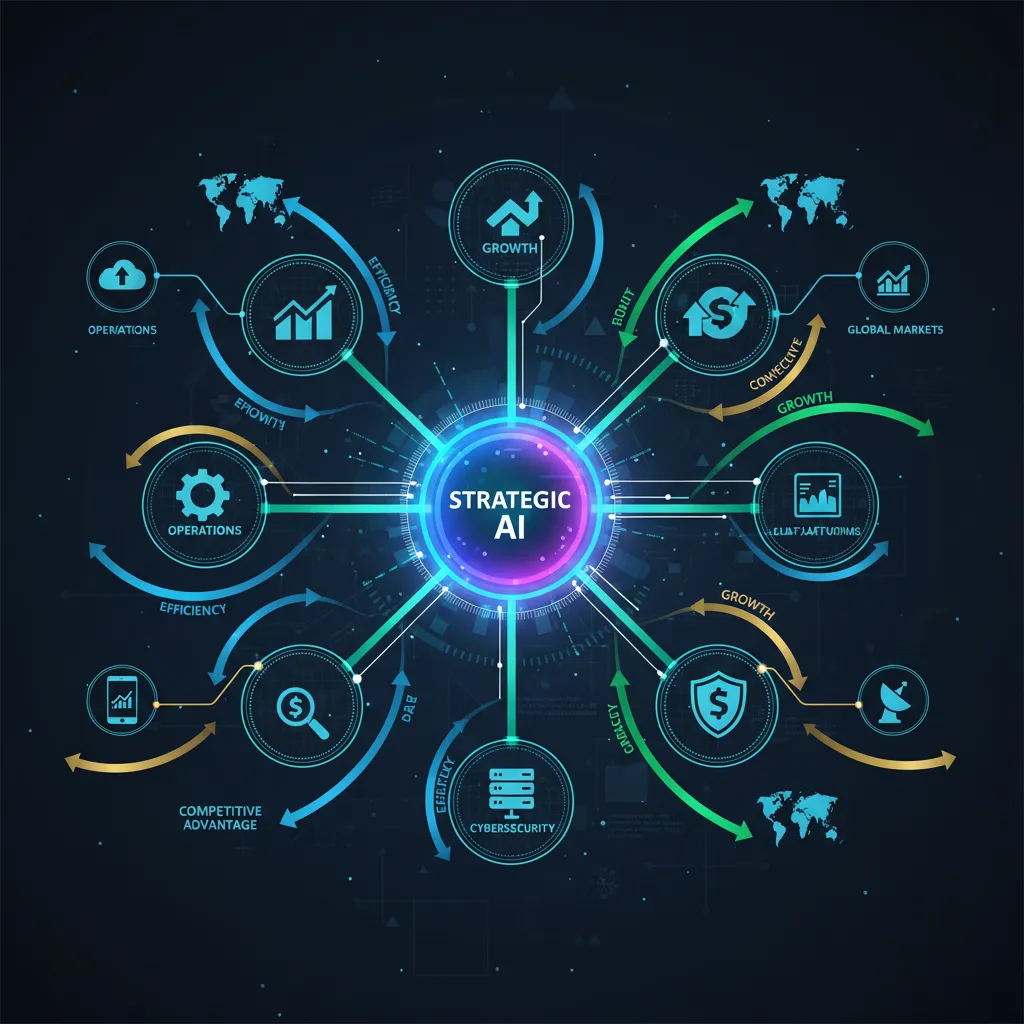
Navigating the Headwinds: Overcoming Common AI Integration Challenges
The path to successful AI integration is rarely smooth. Proactively identifying and planning for common AI integration challenges can significantly increase your chances of success.
The Data Dilemma: Quality, Governance, and Security
Data is the lifeblood of AI. Poor data quality leads to poor AI performance—a concept known as “garbage in, garbage out.” Organizations must invest in robust data governance frameworks to ensure data is accurate, consistent, and secure. This includes establishing clear ownership, defining quality standards, and implementing strong cybersecurity measures to protect sensitive information used in AI models.
The Human Element: Bridging the Talent Gap and Managing Change
Technology is only half the equation. The AI workforce impact is significant, and managing the human element is paramount.
- Talent Gap: The demand for AI experts far outstrips supply. Businesses need a multi-pronged strategy that includes hiring external talent, upskilling the existing workforce, and partnering with specialists.
- Change Management: Employees may fear that AI will replace their jobs. Clear communication is essential. Frame AI as a tool that augments human capabilities, freeing them from tedious tasks to focus on more strategic work. Foster a culture of lifelong learning and adaptation. Related: AI and Your Career: How to Master the Future Job Market
The Ethical Tightrope: Ensuring Responsible and Fair AI
As AI systems make more critical decisions, the importance of AI ethics business practices cannot be overstated. A biased algorithm in AI financial services could unfairly deny loans to certain demographics, or an error in AI healthcare applications could have life-or-death consequences. Building a responsible AI enterprise framework involves:
- Transparency: Making AI decision-making processes as understandable as possible (Explainable AI).
- Fairness: Actively auditing models for bias and ensuring equitable outcomes.
- Accountability: Establishing clear lines of responsibility for the actions of AI systems.
The Financial Question: Calculating ROI and Securing Investment
Calculating the Return on Investment (ROI) for AI can be complex. While some benefits, like cost savings from automation, are easy to quantify, others, like improved decision-making or enhanced customer loyalty, are less tangible. It’s crucial to build a comprehensive business case that includes both hard and soft benefits to secure the necessary investment and maintain executive support throughout the integration journey.
The Future of Business is Intelligent: Key AI Technology Trends for 2024 and Beyond
The field of AI is evolving at a breakneck pace. Staying ahead of the curve is essential for maintaining a competitive edge. Here are some of the key AI innovation trends shaping the future of business AI:
- Generative AI’s Enterprise Expansion: Beyond creating text and images, generative AI business applications are moving into complex enterprise tasks like code generation, synthetic data creation for model training, and advanced engineering simulations.
- Multimodal AI: The next wave of AI will seamlessly understand and process information from multiple sources—text, images, audio, and video—creating a much richer and more contextual understanding of the world.
- AI-Driven Hyperautomation: This trend involves using a combination of AI, machine learning, and robotic process automation (RPA) to automate as many business processes as possible, creating a truly self-optimizing enterprise.
- Explainable AI (XAI): As AI becomes more embedded in critical applications, the demand for transparency is growing. XAI techniques aim to open up the “black box” of complex models, making their decisions understandable and trustworthy for humans.
Related: The Quantum AI Revolution: Unlocking Unprecedented Computing Power
Conclusion
Strategic AI integration is not a one-time project; it is a continuous journey of learning, adapting, and innovating. It’s about fundamentally rewiring your organization’s DNA to think and operate with data and intelligence at its core. By moving beyond isolated tools and adopting a holistic AI business strategy, you can unlock unprecedented levels of efficiency, gain deep customer insights, and build new, resilient business models.
The path is not without its challenges—from data governance to change management—but the rewards are immense. The companies that succeed will be those that view AI not just as a technology to be implemented, but as a strategic capability to be cultivated. They will use it to build a sustainable competitive advantage that will define their market leadership for years to come.
Your journey to becoming an intelligent enterprise starts now. Begin by identifying one critical business challenge, one area of friction, or one untapped opportunity. Then ask: How can AI be the answer?
Frequently Asked Questions (FAQs)
Q1. What is an AI business strategy?
An AI business strategy is a comprehensive plan that details how a company will use artificial intelligence to achieve its long-term goals. It goes beyond simply adopting AI tools; it involves aligning AI initiatives with core business objectives, ensuring data readiness, managing talent, and establishing ethical guidelines to create a sustainable competitive advantage and drive growth.
Q2. How does AI provide a competitive advantage?
AI provides a competitive advantage in several key ways. It enables superior operational efficiency through automation, deeper insights through AI powered analytics for better decision-making, hyper-personalized customer experiences that build loyalty, and the ability to innovate new products, services, and business models faster than competitors.
Q3. What are the biggest challenges in AI implementation?
The most common AI integration challenges include poor data quality and governance, a shortage of skilled AI talent, resistance to change from the existing workforce, and the difficulty of accurately calculating AI ROI business value. Additionally, ensuring ethical and responsible AI use to avoid bias and maintain trust is a significant hurdle.
Q4. What is the difference between AI and business intelligence?
Traditional business intelligence (BI) focuses on descriptive analytics, using historical data to report on what has already happened. Artificial Intelligence (AI) and machine learning go further by enabling predictive analytics (forecasting what will happen) and prescriptive analytics (recommending actions to take), allowing for more proactive and intelligent AI decision making.
Q5. How is generative AI being used in business?
Generative AI business applications are expanding rapidly. Beyond content creation for marketing, it’s used for writing software code, designing new products, creating synthetic data to train other AI models, and powering sophisticated chatbots for customer service. It’s becoming a key tool for accelerating innovation and improving productivity across many departments.
Q6. Can small businesses benefit from AI?
Absolutely. The rise of cloud-based platforms and AI-as-a-Service models has made powerful small business AI solutions more accessible and affordable. Small businesses can leverage AI for targeted marketing, customer service automation, inventory management, and data analysis to compete more effectively with larger corporations.