Llama 3.1 Unleashed: Deep Dive into Meta’s Latest Open-Source AI Model
The world of generative AI moves at a blistering pace, and just when you think you’ve caught up, a new release shifts the entire landscape. Meta has once again ignited the AI community buzz with the launch of Llama 3.1, the highly anticipated successor to its widely acclaimed Llama 3 family. This isn’t just an incremental update; it’s a monumental leap forward for open-source AI.
With a colossal new model, a context window that defies previous limits, and enhanced reasoning capabilities, Llama 3.1 is poised to redefine what’s possible for developers, researchers, and businesses. In this deep dive, we’ll unpack everything you need to know about this groundbreaking release, from its core features and performance benchmarks to its real-world applications and how it stacks up against its predecessor and the competition. Get ready to explore one of the top AI models of 2024.
What is Llama 3.1? A New Era for Open-Source LLMs
Llama 3.1 is the latest generation of large language models (LLMs) from Meta AI, released as part of their commitment to advancing open-source AI development. Unlike proprietary models controlled by a single company, open-source models like Llama 3.1 give the global community of developers and researchers unprecedented access to build, innovate, and customize on top of state-of-the-art AI technology.
This latest release introduces a new family of models, including a compact 8B (8 billion parameters) version, an updated 70B model, and the star of the show: a massive, state-of-the-art 405B parameter model. This new heavyweight contender is designed to compete directly with top-tier closed-source models, offering elite performance while remaining accessible to the wider AI community.
The core philosophy behind Meta’s Llama project is to democratize AI. By sharing these powerful tools, Meta empowers innovators everywhere to create novel applications, conduct vital safety research, and accelerate machine learning advancements on a global scale. Llama 3.1 is the most significant step yet in that mission.

Llama 3.1 vs. Llama 3: A Generational Leap Forward
While Llama 3 was already a powerful and respected model, Llama 3.1 introduces several game-changing improvements that represent a true generational leap. The differences go far beyond just a larger model size; they fundamentally expand the model’s capabilities and potential use cases.
Here’s a breakdown of the key Llama 3.1 improvements:
The Colossal Context Window: From 8K to 1 Million Tokens
Perhaps the most talked-about feature of Llama 3.1 is its expanded context window. Llama 3 supported a context of 8,000 (8K) tokens. Llama 3.1 blows that out of the water, now supporting up to 1 million (1M) tokens in its 405B and 70B models.
What is a context window? Think of it as the model’s short-term memory. It’s the amount of text (input and output) that the model can consider at any one time.
- An 8K token window is like having the memory to read and analyze a few pages of a book.
- A 1M token window is like having the memory to read and analyze the entire The Lord of the Rings trilogy—and still have room to spare.
This massive expansion unlocks a vast range of Llama 3.1 applications that were previously impractical. Users can now feed the model entire books, extensive financial reports, full code repositories, or lengthy research papers and ask for nuanced summaries, detailed analysis, or complex code refactoring across the entire document. This is a transformative capability for deep-dive data analysis and long-form content generation.
Smarter Reasoning and Advanced Code Generation
Meta has significantly enhanced Llama 3.1’s ability to reason, infer, and solve complex problems. This is a direct result of improved training techniques and a more diverse, high-quality pre-training dataset. The model now demonstrates a much stronger grasp of logic, causality, and multi-step instructions.
For developers, this translates into a far more powerful coding assistant. Llama 3.1 exhibits remarkable improvements in code generation, debugging, and explanation. Its performance on industry-standard benchmarks like HumanEval, which tests a model’s ability to write functional code from docstrings, has seen a major boost. This makes it an indispensable tool for programmers looking to streamline their workflows and tackle complex software challenges. Related: The Future of Human-Robot Collaboration: Is AI the Next Frontier?

The New Powerhouse: The Llama 3.1 405B Model
The introduction of the Llama 3.1 405B model is Meta’s boldest move yet in the AI development trends. This model was specifically designed to achieve top-tier performance, putting it in direct competition with the best proprietary models available, such as OpenAI’s GPT-4o and Anthropic’s Claude 3.5 Sonnet.
According to Meta AI’s own benchmarks, the 405B model sets new performance records for open-source LLMs and is highly competitive at the very top of the leaderboards. This allows organizations that prioritize open-source solutions to access elite-level AI capabilities without being locked into a specific provider’s ecosystem.
Llama 3.1 Performance: A Look at the Benchmarks
To understand the true power of Llama 3.1, we need to look at its performance on standardized industry benchmarks. These tests evaluate a model’s capabilities across a wide range of tasks, including general knowledge, reasoning, math, and coding.
Here’s a simplified comparison of how Llama 3.1 stacks up against its predecessor and other leading models:
| Benchmark (Metric) | Llama 3 70B | Llama 3.1 70B | Llama 3.1 405B | GPT-4o / Claude 3.5 Sonnet |
|---|---|---|---|---|
| MMLU (General Knowledge) | 82.0 | 83.6 | 86.1 | Competitive (86-88) |
| GPQA (Grad-Level Q&A) | 39.5 | 43.1 | 50.2 | Competitive (50+) |
| HumanEval (Coding) | 81.7 | 85.6 | 92.2 | Competitive (90-92) |
| MATH (Math Problems) | 52.9 | 55.4 | 65.1 | Competitive (65-70) |
(Note: Scores are simplified representations based on publicly available data from Meta AI and other sources. Performance can vary based on specific test configurations.)
Key Takeaways from the Benchmarks:
- Across the Board Improvements: The Llama 3.1 70B model consistently outperforms its Llama 3 predecessor in every key area.
- Elite Performance: The Llama 3.1 405B model is not just a great open-source model; it’s one of the best AI models in the world, period. Its scores in coding (HumanEval) and advanced reasoning (GPQA) are particularly impressive, establishing it as a state-of-the-art leader.
- Closing the Gap: This release significantly narrows the performance gap between open-source and closed-source models, providing a powerful, transparent alternative for the entire AI ecosystem. Related: Unlocking New Realities: How AI Will Power the Future of Spatial Computing
Real-World Applications and Use Cases for Llama 3.1
The theoretical advancements and impressive benchmarks of Llama 3.1 translate into a vast array of practical, real-world applications. The combination of a massive context window and superior reasoning unlocks new possibilities for businesses, researchers, and individual users.
For Developers and Businesses
- Hyper-Intelligent Customer Service: Build conversational AI agents that can access and understand an entire customer history or a vast knowledge base in real-time to provide accurate, personalized support.
- Advanced Code Assistants: Integrate Llama 3.1 into IDEs to help developers write, debug, and manage entire code repositories, drastically improving productivity and code quality.
- Large-Scale Document Analysis: Automate the process of analyzing legal contracts, financial filings, or compliance documents. Llama 3.1 can ingest hundreds of pages and instantly extract key clauses, identify risks, or summarize critical information. Related: The AI Revolution in Finance: How Artificial Intelligence is Shaping the Future of Your Wallet
- Strategic Content Creation: Generate long-form, high-quality content like white papers, market reports, or technical manuals by providing the model with extensive source material and high-level directives.
For Researchers and Academics
- Accelerated Literature Reviews: Feed the model hundreds of research papers and ask it to synthesize findings, identify knowledge gaps, or generate summaries of the current state of a scientific field.
- Data Interpretation: Analyze large, unstructured datasets from experiments or studies, helping to identify patterns and formulate hypotheses that might be missed by human researchers.
- Scientific Discovery: Use the model as a brainstorming partner to explore complex scientific problems, leveraging its vast knowledge base and reasoning skills. Related: How AI is Revolutionizing Biodiversity Conservation Efforts
For Everyday Users and Creatives
- Smarter Personal Assistants: Imagine an AI assistant that remembers every conversation you’ve ever had with it, providing truly personalized and context-aware help.
- Creative Writing Partner: Co-write a novel by giving the AI the entire manuscript to date, ensuring perfect continuity of plot, character voice, and tone as it helps you draft new chapters.
- Personalized Tutoring: Create a learning companion that can process an entire textbook and then quiz you, explain complex concepts in different ways, and adapt to your learning style. Related: Unlocking Potential: How AI is Revolutionizing Personalized Learning
How to Access and Use Llama 3.1
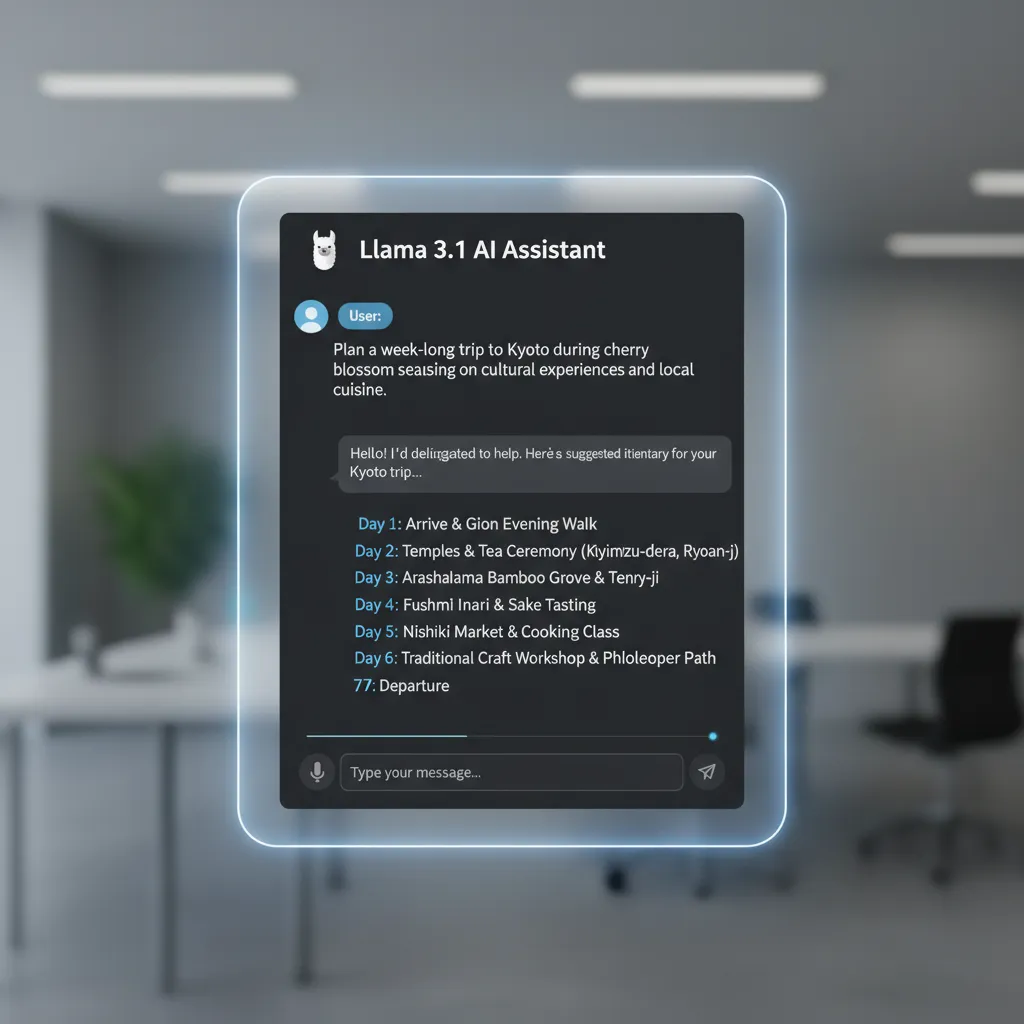
Meta has made Llama 3.1 widely available through a variety of platforms to ensure the community can start building with it immediately. You can access the models through:
- Model Hubs: Download the models directly from platforms like Hugging Face and Meta Llama.
- Cloud Providers: Llama 3.1 is available on major cloud platforms including AWS, Google Cloud, and Microsoft Azure, allowing for scalable deployment.
- Hardware Partners: Meta has collaborated with leading hardware companies like NVIDIA, AMD, Intel, and Qualcomm to optimize the models for a wide range of devices, from powerful servers to edge devices.
As with previous releases, Meta emphasizes responsible AI development. Users are required to adhere to an acceptable use policy to prevent misuse, and Meta provides resources like Llama Guard 2 and Code Shield to help developers build safer applications.
The Future is Open: Llama 3.1’s Impact on the AI Landscape
The release of Llama 3.1 is more than just a new product; it’s a powerful statement about the future of AI. By pushing the boundaries of what’s possible with open-source models, Meta is fostering a more competitive, innovative, and transparent AI ecosystem. This move challenges the dominance of closed-source models and empowers a new generation of creators to build the future of AI.
The AI community’s ability to scrutinize, fine-tune, and build upon Llama 3.1 will lead to faster innovation, more robust safety standards, and a wider distribution of the benefits of AI technology. It signals a trend toward a future where the most powerful AI isn’t locked away but is a shared resource for global progress. As we explore concepts like Sustainable AI: Eco-Friendly Innovation for a Greener Digital Future, having open models is crucial for transparently measuring and improving efficiency.
Conclusion
Meta Llama 3.1 is a landmark achievement in the world of large language models. With its state-of-the-art 405B model, an unprecedented 1 million token context window, and significantly improved reasoning and coding abilities, it sets a new standard for open-source AI. It is a testament to the incredible pace of machine learning advancements and a powerful tool that will undoubtedly fuel the next wave of AI research breakthroughs.
By delivering performance that rivals the best proprietary models, Llama 3.1 provides the AI community with a powerful, accessible, and transparent alternative. The future of AI is collaborative, and with this release, Meta has invited everyone to the table. The only question now is: what will you build with it?
Frequently Asked Questions (FAQs)
### Q1. What is Meta Llama 3.1?
Llama 3.1 is the latest generation of open-source large language models (LLMs) from Meta. It includes a family of models (8B, 70B, and a new 405B) with significant improvements, most notably a massive 1 million token context window and state-of-the-art performance in reasoning and code generation.
### Q2. What is the biggest improvement in Llama 3.1 vs Llama 3?
The most significant improvement is the expansion of the context window from 8,000 tokens in Llama 3 to up to 1 million tokens in Llama 3.1 (405B and 70B models). This allows the model to process and analyze incredibly large amounts of text, like entire books or codebases, at once.
### Q3. How does Llama 3.1 405B compare to GPT-4o?
The Llama 3.1 405B model is designed to be highly competitive with top-tier models like GPT-4o. On several key industry benchmarks for reasoning, math, and coding, it performs at a similar state-of-the-art level, making it one of the most powerful open-source models ever released.
### Q4. Is Llama 3.1 free to use?
Yes, Llama 3.1 models are free for both research and commercial use, subject to the terms of Meta’s license and acceptable use policy. This open-source approach allows developers and businesses to integrate the models into their applications without licensing fees.
### Q5. How can I download or access Llama 3.1?
You can access Llama 3.1 through multiple channels. The models are available for download on hubs like Hugging Face, can be deployed via major cloud providers like AWS and Google Cloud, and are supported by hardware partners such as NVIDIA for optimized performance.
### Q6. What does a 1 million token context window mean in practice?
A 1 million token context window means the AI can “remember” and process approximately 750,000 words at a time. This enables complex tasks like summarizing multiple long documents, maintaining a very long and detailed conversation, or analyzing an entire software project’s codebase for bugs or improvements.
### Q7. What are the primary use cases for Llama 3.1?
Key use cases include advanced conversational AI and customer service bots, powerful developer assistants for code generation and debugging, large-scale document analysis for legal and financial industries, and sophisticated content creation for marketing and research.