Llama 3.1: Build Custom AI Applications with Open-Source Power

Introduction
The age of generic, one-size-fits-all AI is rapidly coming to a close. Businesses and developers are no longer content with closed-off, black-box models that offer limited flexibility and carry hefty price tags. The demand is for AI that is specialized, secure, and deeply integrated into unique workflows. This is where the open-source revolution, supercharged by Meta’s Llama 3.1, is changing the game.
If you’ve ever felt constrained by proprietary AI, wondering how to build a solution that truly understands your company’s data, brand voice, or specific industry needs, you’re in the right place. Llama 3.1 isn’t just another incremental update; it’s a powerful toolkit for building bespoke, enterprise-grade custom AI applications. It represents a significant leap forward for open-source AI, giving you unprecedented control over your AI destiny.
This comprehensive guide will walk you through the entire journey of harnessing Llama 3.1. We’ll explore its powerful new features, outline a strategic blueprint for building your first application, dive deep into the art of fine-tuning Llama 3.1 for specialized tasks, and map out the path to successful deployment. By the end, you’ll understand how to leverage this state-of-the-art model to create generative AI custom solutions that drive real business value.
What is Llama 3.1? A New Frontier for Open-Source AI
Llama 3.1 is the latest family of large language models (LLMs) from Meta, released under a permissive license that allows for both research and commercial use. This release solidifies Meta’s commitment to the open-source community, providing a powerful alternative to closed models like OpenAI’s GPT series and Google’s Gemini. But what makes it so special?
Beyond the Hype: Key Features and Model Sizes
Llama 3.1 isn’t a single model but a suite of options designed to fit diverse needs, from lightweight on-device tasks to massive, complex reasoning.
- Llama 3.1 8B: The smallest and most agile model, perfect for edge AI applications on mobile devices or laptops, rapid prototyping, and tasks where low latency is critical.
- Llama 3.1 70B: The balanced workhorse. It offers a fantastic blend of performance and efficiency, suitable for a wide range of enterprise solutions, including sophisticated custom chatbots and content creation tools.
- Llama 3.1 405B: The new powerhouse. This model is one of the largest and most capable open-source models ever released. It excels at complex reasoning, deep analysis, and multi-step tasks, competing directly with top-tier proprietary models.
- Llama Code 3.1: A specialized version fine-tuned for code generation, understanding, and debugging, making it an invaluable tool for developers.
Beyond the model sizes, Llama 3.1 introduces critical architectural improvements:
- Expanded Context Window: With the ability to process up to 1 million tokens, Llama 3.1 can analyze vast documents, entire codebases, or lengthy conversations in a single pass.
- Enhanced Multilingual Capabilities: The model shows significantly improved performance in languages beyond English, opening up global possibilities for AI application development.
- Superior Reasoning and Reduced Refusals: Meta has focused on making the model more helpful and better at following complex instructions, a key requirement for reliable AI workflow automation.
The Open-Source Advantage: Why It Matters for Your Business
Choosing an open source LLM for business isn’t just a technical decision; it’s a strategic one. The benefits are transformative:
- Unmatched Control & Customization: You can modify the model’s architecture, fine-tune it on your proprietary data, and truly own your AI stack. This level of AI model customization is impossible with closed APIs.
- Significant Cost Savings: While you need to manage the infrastructure, you eliminate the often-unpredictable per-token API costs associated with proprietary models. For scalable AI applications, this can lead to massive long-term savings.
- Enhanced Security & Privacy: You can deploy Llama 3.1 on your own servers—whether on-premise or in a private cloud. This means your sensitive data never leaves your control, a non-negotiable for industries like finance, healthcare, and legal. Related: AI in Financial Fraud Detection: The New Frontier of Cybersecurity
- Transparency & Trust: With open-source models, you can inspect the code and understand its workings. This transparency builds trust and allows for better risk management and compliance with regulations.
- Future-Proofing: You are not locked into a single vendor’s ecosystem. The vibrant open-source community constantly contributes new tools, techniques, and improvements, fostering rapid AI innovation.
The Blueprint: Building Your First Custom AI Application with Llama 3.1
Ready to move from theory to practice? Building a custom AI solution with Llama 3.1 involves a clear, strategic process. Here’s a step-by-step blueprint for llama 3.1 development.
Step 1: Define Your Use Case and Goals
Before writing a single line of code, you must answer the most important question: What problem are you trying to solve? A clear objective is the foundation of a successful AI project.
Common Llama 3.1 Use Cases:
- Intelligent Customer Support: Create AI assistants that can answer complex queries, understand customer history, and escalate issues intelligently, all while maintaining your brand’s unique voice.
- Internal Knowledge Management: Build a “chatbot for your business” that allows employees to query internal documents, HR policies, and technical wikis using natural language.
- Content Generation & Marketing: Automate the creation of product descriptions, social media posts, and email marketing campaigns, fine-tuned on your past high-performing content.
- Data Analysis & Summarization: Develop tools that can read through thousands of customer reviews, financial reports, or legal documents and provide concise, actionable summaries.
- AI Workflow Automation: Integrate Llama 3.1 to automate multi-step processes, like routing support tickets, triaging bug reports, or generating meeting minutes.
Step 2: Choose the Right Llama 3.1 Model
Your use case will directly inform your model choice. It’s a trade-off between capability, speed, and cost.
| Model | Best For | Considerations |
|---|---|---|
| Llama 3.1 8B | Edge AI, mobile apps, chatbots with fast responses, cost-sensitive projects. | Less nuanced understanding of highly complex topics. |
| Llama 3.1 70B | General-purpose enterprise AI, content creation, RAG systems, most business workflows. | Requires more powerful GPU infrastructure than the 8B model. |
| Llama 3.1 405B | Complex reasoning, scientific research, deep financial analysis, multi-step agentic workflows. | Significant computational cost; requires high-end, multi-GPU servers. |
For most startups and enterprise teams starting out, the Llama 3.1 70B model offers the best balance, providing state-of-the-art performance for a wide range of tasks.
Step 3: Set Up Your Development Environment
To start building, you’ll need the right tools. The open-source ecosystem around Llama 3.1 is incredibly rich.

Key AI Development Tools for Llama 3.1:
- Hugging Face Transformers: The de facto library for downloading, running, and fine-tuning LLMs. It makes working with Llama 3.1 incredibly accessible.
- PyTorch: The underlying deep learning framework used by Llama 3.1.
- AI Application Frameworks: Tools like LangChain and LlamaIndex are essential for building complex applications. They provide the connective tissue for chaining model calls, managing memory, and connecting to external data sources (like databases or APIs).
- Hardware: A powerful GPU (like an NVIDIA A100 or H100) is crucial for efficient fine-tuning and hosting. Cloud providers like AWS, Google Cloud, and Azure offer on-demand access to this hardware.
Unleashing Full Potential: Fine-Tuning Llama 3.1 for Your Domain
While the base Llama 3.1 models are incredibly capable, their true power is unlocked through fine-tuning. This is the process of taking the pre-trained model and further training it on your own specific, high-quality data.
What is Fine-Tuning and Why Do You Need It?
Think of the base Llama 3.1 model as a brilliant, highly educated graduate with vast general knowledge. Fine-tuning is like giving that graduate intensive, on-the-job training for a specific role at your company.
Benefits of fine-tuning:
- Domain Specialization: Teach the model your industry’s jargon, your company’s product names, and your specific business processes.
- Improved Accuracy & Reliability: Drastically reduce errors and “hallucinations” by grounding the model in your factual data.
- Brand Voice Alignment: Ensure the AI’s responses perfectly match your company’s tone—whether it’s professional, witty, or empathetic.
- Task Mastery: Train the model to excel at a specific format or task, such as writing SQL queries, summarizing medical records, or drafting legal clauses.
The Fine-Tuning Workflow: A Practical Overview
AI model training and fine-tuning require a methodical approach, with data quality being the most important factor.
- Data Curation and Preparation: This is 80% of the work. You need to assemble a high-quality dataset of examples for the task you want the model to learn. For a customer service chatbot, this might be thousands of pairs of “customer question” and “ideal agent response.” The data must be clean, accurate, and consistently formatted.
- Choosing a Fine-Tuning Technique: Full fine-tuning (retraining all model weights) is computationally expensive. Modern techniques like LoRA (Low-Rank Adaptation) and QLoRA offer a much more efficient alternative. They work by training only a small fraction of the model’s parameters, drastically reducing memory and compute requirements without sacrificing much performance.
- The Training Loop: Using a framework like PyTorch and libraries from Hugging Face, you run the training process, feeding your dataset to the model and adjusting its weights to minimize errors.
- Evaluation and Iteration: After training, you must rigorously test the model. Compare its performance against the base model and against a “holdout” set of your data. Fine-tuning is an iterative process of improving your dataset and tweaking training parameters.
Prompt Engineering: The Other Side of Customization
Don’t underestimate the power of prompt engineering. Even without fine-tuning, you can significantly customize the model’s behavior through carefully crafted instructions. Advanced techniques like creating detailed system prompts, providing few-shot examples within the prompt, and using chain-of-thought reasoning can guide the base model to perform highly specific tasks effectively. For many llama 3.1 use cases, a combination of a strong system prompt and a Retrieval-Augmented Generation (RAG) system is more than sufficient. Related: AI for Enhanced Hobbies: A New Wave of Creative Pursuits
From Development to Deployment: Bringing Your AI Solution to Life
A custom AI model is only valuable when it’s integrated into a live application. The AI solution architecture for Llama 3.1 needs to be robust, scalable, and secure.
Choosing Your Deployment Strategy
You have several options for where and how your model will run:
- Cloud Platforms (AWS, GCP, Azure): These providers offer managed services (like Amazon SageMaker or Azure Machine Learning) that simplify deployment, scaling, and monitoring. This is the most common path for enterprise solutions.
- On-Premise: For maximum security and data privacy, you can host the model on your own servers. This requires significant infrastructure and MLOps expertise but gives you complete control.
- Edge AI: For applications requiring real-time responses and offline functionality, smaller models like Llama 3.1 8B can be deployed directly on devices like smartphones or IoT gateways.
Key Tools for Scalable Deployment
Simply running a model in a Python script won’t work for a production application. You need specialized tools to serve the model efficiently.
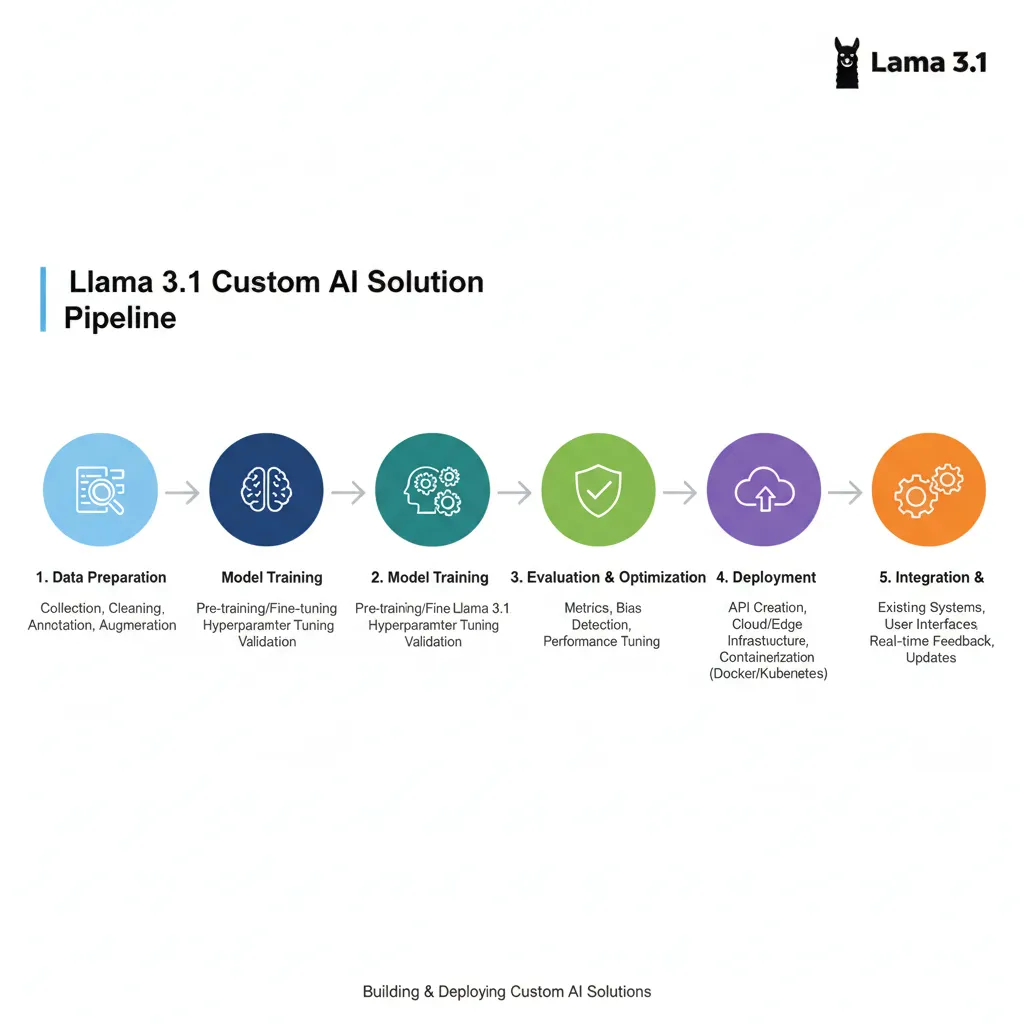
- Inference Servers: Tools like vLLM, Text Generation Inference (TGI), and TensorRT-LLM are optimized to handle many concurrent requests, maximizing throughput and minimizing latency.
- Containerization & Orchestration: Using Docker to package your application and Kubernetes to manage it allows for automatic scaling, fault tolerance, and consistent deployments across different environments.
- API Integration: Your deployed model needs a well-defined Llama 3.1 API integration layer (e.g., a REST API built with FastAPI) so that your other applications can communicate with it.
Security and Governance for Enterprise-Grade AI
When building with open-source models, Llama 3.1 security is paramount. Meta provides tools like Llama Guard 2 to classify inputs and outputs, helping to filter out unsafe content. Additionally, Code Shield can help secure code generated by Llama Code. A comprehensive security strategy involves input validation, output monitoring, access controls, and regular model audits.
Real-World Llama 3.1 Use Cases and Enterprise Solutions
The potential of custom large language models like Llama 3.1 is vast. Here are a few concrete examples of how businesses can leverage this technology.
Revolutionizing Customer Service with Custom Chatbots
An e-commerce company can fine-tune Llama 3.1 on its entire product catalog, past customer support chats, and FAQ documents. The resulting chatbot can handle highly specific product questions, understand order-related issues, and even process returns, freeing up human agents for the most complex cases. Related: AI Travel Planning: How to Plan Your Dream Trip in a Fraction of the Time
Building Powerful Internal AI Assistants
A financial advisory firm can deploy a 70B model on its private cloud, feeding it decades of market analysis reports, client portfolio data, and compliance documents. Advisors can then ask complex questions in natural language, such as, “Summarize the key risks and opportunities for a client in the tech sector with a moderate risk tolerance based on last quarter’s reports.”

Powering AI Innovation for Startups
Llama 3.1 for startups is a massive competitive advantage. A small startup building a novel legal tech tool can fine-tune Llama 3.1 on a specific area of law, creating a specialized product that rivals those from much larger companies, all without paying prohibitive API fees. This levels the playing field and accelerates innovation.
Conclusion: The Future of Custom AI is Open
Meta’s Llama 3.1 is more than just a powerful set of models; it’s a catalyst for a new wave of AI innovation. By embracing the open-source ethos, it empowers developers, startups, and enterprises to move beyond the limitations of proprietary AI and build solutions that are truly their own.
The journey from idea to a fully deployed custom AI application requires a blend of strategic vision, technical expertise, and a deep understanding of your data. By leveraging the power of Llama 3.1 development, focusing on high-quality fine-tuning, and implementing a robust deployment strategy, you can create intelligent, scalable, and secure applications that provide a lasting competitive edge.
The era of custom, open-source AI is here. It’s time to start building.
Frequently Asked Questions (FAQs)
Q1. What is Llama 3.1?
Llama 3.1 is the latest family of open-source large language models (LLMs) developed by Meta. It includes several models of different sizes (8B, 70B, 405B) designed for a wide range of tasks, from on-device applications to complex reasoning, and is available for both commercial and research use.
Q2. Is Llama 3.1 free for commercial use?
Yes, Llama 3.1 is available under a permissive license that allows for commercial use. However, companies with over 700 million monthly active users may need to request a special license from Meta. For the vast majority of startups and enterprises, it is free to use for building commercial products.
Q3. How is Llama 3.1 different from models like GPT-4o?
The primary difference is its open-source nature. While GPT-4o is a proprietary model accessed via a paid API, Llama 3.1’s weights are publicly available. This allows you to download, modify, fine-tune, and host the model yourself, providing greater control, customization, and data privacy. Performance-wise, the largest Llama 3.1 405B model is competitive with top-tier models like GPT-4o on many industry benchmarks. Related: What Is GPT-4o? A Deep Dive into OpenAI’s Multimodal AI
Q4. What do I need to start developing with Llama 3.1?
To get started, you’ll need a solid understanding of Python and machine learning concepts. You will also need access to a development environment with powerful GPUs (either locally or through a cloud provider) and familiarity with libraries like Hugging Face Transformers, PyTorch, and frameworks like LangChain.
Q5. What does it mean to “fine-tune” an AI model?
Fine-tuning is the process of taking a pre-trained general-purpose model like Llama 3.1 and continuing its training on a smaller, specific dataset. This adapts the model to excel at a particular task, learn a specific domain’s language, or adopt a certain style, making it far more accurate and useful for your custom application.
Q6. Can Llama 3.1 run on local hardware?
Yes, the smaller models, particularly Llama 3.1 8B, are designed to run efficiently on high-end consumer hardware, such as laptops with modern GPUs or even on-device for mobile applications. The larger models (70B and 405B) require powerful, server-grade GPUs for effective operation.
Q7. What is the difference between fine-tuning and prompt engineering?
Prompt engineering involves crafting detailed instructions (prompts) to guide a base model’s behavior without changing the model itself. Fine-tuning involves actually retraining parts of the model on new data to permanently alter its knowledge and skills. They are often used together; a well-fine-tuned model will still benefit from good prompt engineering.