Llama 3.1: Advanced Open-Source AI for Developers & Enterprises
Introduction
The world of artificial intelligence is moving at a breathtaking pace, and the open-source community is not just keeping up—it’s setting the tempo. In this dynamic landscape, Meta has once again raised the bar with the release of Meta Llama 3.1, a significant evolution in their family of open-source AI models. This isn’t just an incremental update; it’s a monumental leap forward, fundamentally reshaping the possibilities for developers, researchers, and enterprises around the globe.
Following the massive success of Llama 3, the launch of Llama 3.1 introduces a new powerhouse model, expands critical capabilities, and reinforces the mission of democratizing AI. With a colossal 405-billion parameter model, an expanded context window, and state-of-the-art performance, Llama 3.1 is poised to challenge even the most advanced proprietary systems.
This comprehensive guide will unpack everything you need to know about this next generation AI model. We’ll explore the groundbreaking Llama 3.1 features, conduct a detailed Llama 3.1 vs Llama 3 comparison, analyze its impressive performance benchmarks, and dive deep into practical Llama 3.1 enterprise use cases and developer applications. Whether you’re a developer eager to build with the latest AI tools for developers or a business leader crafting AI for business solutions, this article will illuminate the path forward in the era of open, accessible, and powerful generative AI.
What is Llama 3.1? The Next Leap in Open-Source AI
Meta Llama 3.1 is the latest iteration of the Llama family, a series of large language models (LLMs) developed by Meta and released openly to the public. It builds upon the strong foundation of Llama 3, which was already highly regarded for its performance and efficiency. Llama 3.1 continues Meta’s commitment to “open innovation,” providing a powerful alternative to the closed, proprietary models that dominate the market.
At its core, Llama 3.1 is a family of text-based generative AI models, including the existing high-performing 8B and 70B parameter versions, and now, a new flagship model: Llama 3.1 405B. This 405-billion parameter model represents a massive scaling in size and capability, designed to handle highly complex reasoning, nuanced content generation, and sophisticated problem-solving tasks.
The release is more than just a new model; it’s a strategic enhancement of the entire Llama 3.1 ecosystem. The core philosophy remains unchanged: to foster a collaborative and transparent environment for AI model development that accelerates progress and ensures powerful technology is accessible to all. This approach empowers a global Llama 3.1 community to inspect, adapt, and innovate on top of a state-of-the-art foundation.
Llama 3.1 vs Llama 3: A Generational Upgrade
While Llama 3 was a formidable model in its own right, Llama 3.1 introduces several game-changing advancements. Understanding these differences is key to appreciating the Llama 3.1 impact on the AI landscape.
| Feature | Llama 3 | Llama 3.1 | Significance |
|---|---|---|---|
| Largest Model | 70B Parameters | 405B Parameters | A ~6x increase in size, enabling vastly more complex reasoning and knowledge capacity, competing with top-tier models like GPT-4o. |
| Context Window | 8K Tokens | 128K Tokens | A 16x increase, allowing the model to process and recall information from extensive documents, codebases, or long conversations. |
| Coding Ability | Strong | Significantly Improved | New benchmarks show superior performance in code generation, debugging, and following complex programming instructions. |
| Reasoning | Advanced | State-of-the-Art | The 405B model excels at multi-step reasoning, logical puzzles, and complex problem-solving tasks. |
| Ecosystem Tools | Llama Guard, etc. | Llama Guard 2, Code Shield | Enhanced safety and security tools for building responsible AI applications, crucial for enterprise adoption. |
The Colossal 405B Model: A New Heavyweight Champion
The star of the show is undoubtedly the Llama 3.1 405B model. With 405 billion parameters, it enters the elite class of large language models open source, rivaling the capabilities of closed-source giants. This scale allows it to capture a deeper and more nuanced understanding of language, logic, and context, leading to higher-quality outputs across the board.
Expanded Context Window: From a Paragraph to a Novel
The leap from an 8K to a 128K context window is a massive quality-of-life and capability improvement. This means the model can “remember” and reference information across approximately 100,000 words. This is a game-changer for Llama 3.1 applications such as:
- Analyzing lengthy reports: Summarize and query entire financial reports, legal documents, or research papers.
- Working with large codebases: Understand the full context of a software project for better code generation and debugging.
- Maintaining long conversations: Power chatbots and virtual assistants that don’t lose track of the conversation history.
Related: Deep Work Mastery: Unlock Focus & Boost Productivity in a Distracted World
Deep Dive into Llama 3.1 Features & Performance
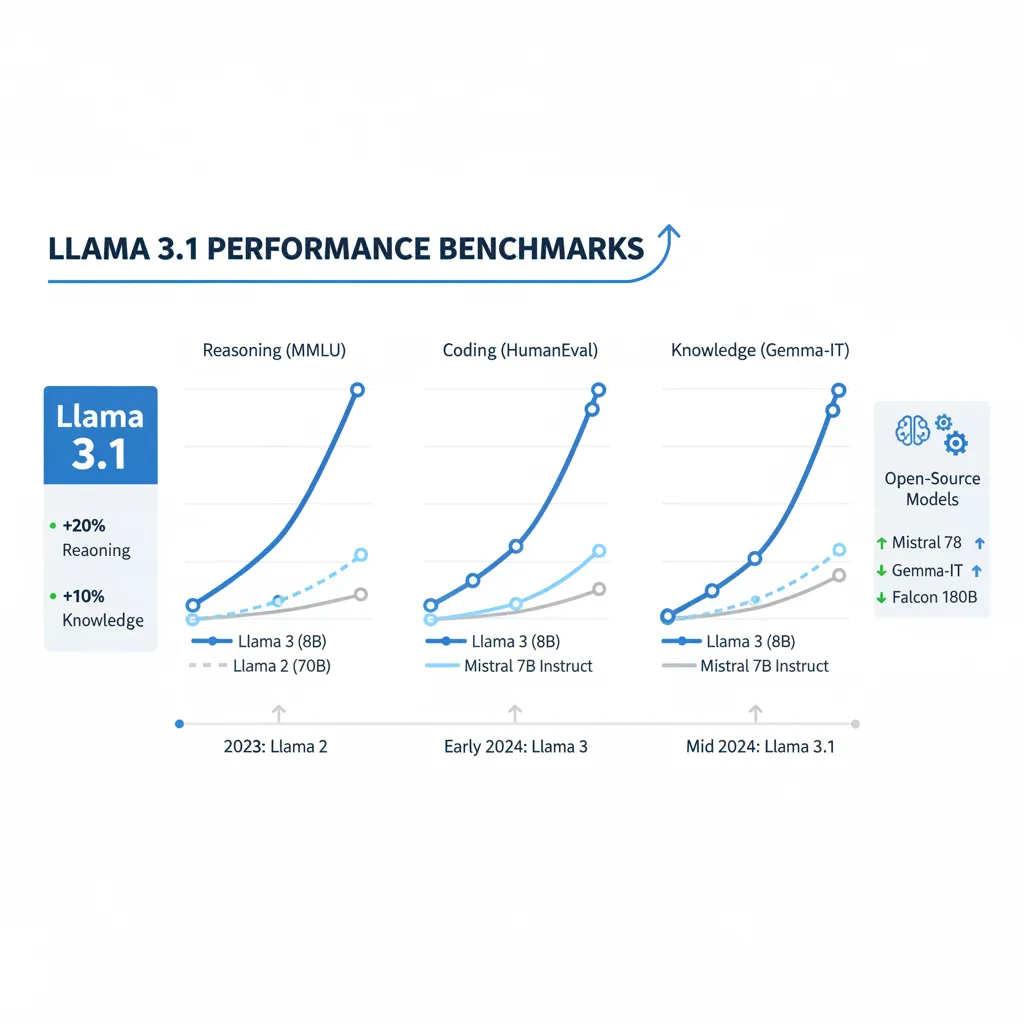
The Llama 3.1 performance is not just a claim; it’s backed by a suite of rigorous Llama 3.1 benchmarks. Meta has demonstrated that the 405B model, in particular, achieves state-of-the-art results, often outperforming or matching leading proprietary models.
Unprecedented Benchmarking Performance
Across a wide range of industry-standard benchmarks, Llama 3.1 405B has proven its mettle:
- MMLU (Massive Multitask Language Understanding): It shows exceptional general knowledge and problem-solving skills.
- HumanEval: It demonstrates a significant leap in coding proficiency, outperforming many specialized coding models.
- GPQA (Graduate-Level Google-Proof Q&A): This benchmark tests for deep reasoning ability, where Llama 3.1 shows expert-level performance.
These results signal that open source machine learning is no longer a step behind proprietary systems. For many tasks, it is now a viable, and often superior, alternative.
Superior Coding and Agentic Capabilities
One of the most significant areas of improvement is in AI in software development. Llama 3.1 is an exceptionally powerful coding assistant. It can:
- Generate complex code snippets in various programming languages.
- Act as a “reasoning engine” to help debug complex issues.
- Translate code between languages.
- Automate the creation of documentation and unit tests.
This makes it one of the most powerful AI tools for developers, capable of significantly accelerating development cycles and improving code quality.
Enhanced Safety and Responsibility by Design
With great power comes great responsibility. Meta has placed a strong emphasis on the safe and ethical deployment of Llama 3.1. The ecosystem includes updated tools like:
- Llama Guard 2: A state-of-the-art model for classifying input (prompts) and output (responses) to prevent the generation of unsafe or harmful content.
- Code Shield: A specialized tool designed to filter out insecure code suggestions, reducing the risk of introducing vulnerabilities into software.
- CyberSec Eval 2: An expanded set of benchmarks to rigorously test and mitigate risks related to code interpretation, cybersecurity, and prompt injection attacks.
This focus on safety is critical for fostering trust and enabling the widespread adoption of AI for enterprises 2024.
Related: AI-Ethical Wildlife Tourism for Sustainable Adventures
Llama 3.1 for Developers: A Practical Guide
Llama 3.1 is designed to be accessible and versatile, empowering developers to build the next generation of AI-powered applications.

Getting Started with the Llama 3.1 Ecosystem
The Llama 3.1 developer guide starts with accessibility. Developers can get their hands on the models through various channels:
- Direct Download: Available directly from Meta.
- Hugging Face: The leading platform for open-source machine learning, offering easy access to models and tools.
- Cloud Platforms: Major providers like AWS, Google Cloud, and Microsoft Azure offer optimized environments for
deploying Llama 3.1. - Hardware Partners: Integration with hardware from NVIDIA, AMD, Intel, and Qualcomm ensures optimized performance across different infrastructures.
Fine-Tuning Llama 3.1 for Custom Applications
While the base Llama 3.1 models are incredibly powerful, their true potential is unlocked through customization. Fine-tuning Llama 3.1 allows developers to adapt the model for specific tasks or domains. This process involves training the model further on a smaller, curated dataset.
Imagine creating custom AI models Llama 3.1 for:
- A specialized medical chatbot trained on medical literature.
- A legal assistant that understands the nuances of contract law.
- A creative writing partner that can mimic a specific author’s style.
Fine-tuning provides a path to highly differentiated and valuable AI solutions without the astronomical cost of training a foundation model from scratch.
Deploying Llama 3.1: From Cloud to On-Premise
The flexibility of Llama 3.1 integration extends to deployment. Developers and businesses can choose the option that best suits their needs for security, scalability, and cost:
- Cloud Deployment: Leverage managed services on major cloud platforms for easy scaling and maintenance.
- On-Premise Deployment: For organizations with strict data privacy and security requirements, running Llama 3.1 on their own hardware provides maximum control.
- Edge Deployment: Smaller models like Llama 3.1 8B can even be optimized to run on local devices, enabling AI applications with low latency and offline capabilities.
Llama 3.1 for Enterprises: Unlocking Business Value
The maturity and performance of Llama 3.1 make it a compelling proposition for businesses looking to integrate generative AI into their operations. It offers a powerful blend of cutting-edge capability and strategic control.

Strategic Llama 3.1 Enterprise Use Cases
The potential Llama 3.1 enterprise use cases are vast and transformative:
- Hyper-Personalized Customer Service: Power chatbots that can access a customer’s entire history (thanks to the 128K context window) to provide truly personalized and effective support.
- Advanced Data Analysis & Insight Generation: Analyze complex internal documents, market research, and financial reports to uncover trends and generate strategic insights.
- Accelerated R&D: Assist scientists and engineers in parsing research papers, analyzing experimental data, and even generating hypotheses.
- Efficient Internal Knowledge Management: Create an internal search engine that can understand natural language queries and provide precise answers from a company’s entire knowledge base.
- Marketing & Content Creation: Automate the drafting of marketing copy, social media posts, and internal communications with a consistent brand voice.
The Business Case for Open-Source AI
The Llama 3.1 benefits extend beyond technical capabilities, offering significant strategic advantages for businesses:
- Data Sovereignty and Privacy: By self-hosting, companies ensure their sensitive proprietary data never leaves their control.
- Cost Efficiency: Avoids per-token or per-call API fees associated with proprietary models, leading to more predictable and potentially lower costs at scale.
- Deep Customization: Businesses can fine-tune the model on their own data to create a unique competitive advantage that cannot be easily replicated.
- No Vendor Lock-In: The open nature of Llama 3.1 allows businesses to switch hosting providers or infrastructure without being tied to a single vendor’s ecosystem.
Related: AI in Real Estate: The Future of Property Investing and Management
Building a Robust AI Ecosystem
The power of an open-source model is amplified by its community. The Llama 3.1 ecosystem is a vibrant network of developers, researchers, and companies building tools, sharing knowledge, and pushing the boundaries of what’s possible. This collaborative environment accelerates Llama 3.1 innovation, providing businesses with a rich pool of talent and resources to draw from.
The Future is Open: Llama 3.1’s Impact on the AI Landscape
The release of Llama 3.1 is more than just a product launch; it’s a statement about the future of open-source AI. It proves that the open model of development can produce results that are not just competitive with, but in some cases superior to, the world’s most advanced closed-source systems.
This trend of generative AI open source is fundamentally changing the industry by:
- Lowering the barrier to entry for AI innovation.
- Increasing transparency and scrutiny of AI models.
- Fostering a more diverse and competitive AI market.
Llama 3.1 acts as a powerful catalyst for this movement, providing a robust, reliable, and responsible foundation for the next wave of AI-driven transformation.
Related: Google AI Overviews: The Future of Search and SEO
Conclusion
Meta Llama 3.1 is a landmark achievement in the journey of open source machine learning. By delivering a new 405B parameter model, a massive 128K context window, and state-of-the-art performance, Meta has provided the global community with a tool of unprecedented power and potential.
For developers, it represents a new playground for AI in software development, offering unparalleled flexibility for building sophisticated and custom AI models Llama 3.1. For enterprises, it unlocks a path to leveraging cutting-edge AI while maintaining control over data, costs, and strategic direction.
The Llama 3.1 impact will be felt across every industry as it empowers a new generation of innovation. It stands as a testament to the power of open collaboration and marks a pivotal moment in the democratizing AI movement. The future of AI is not just being built by a handful of large corporations; it’s being built by a global community, and Llama 3.1 is one of its most powerful tools. The only question left is: what will you build with it?
Frequently Asked Questions (FAQs)
Q1. What are the main new features of Llama 3.1?
The primary new features of Llama 3.1 are the introduction of a massive 405-billion parameter model, a significantly expanded context window of 128K tokens (up from 8K in Llama 3), and greatly improved performance in coding, reasoning, and other complex tasks. It also includes enhanced safety tools like Llama Guard 2 and Code Shield.
Q2. Is Llama 3.1 405B better than models like GPT-4o?
Llama 3.1 405B is highly competitive and achieves state-of-the-art results that are comparable to, and in some specific benchmarks, even exceed those of leading proprietary models like GPT-4o. The key advantage of Llama 3.1 is its open-source nature, giving users more control and flexibility.
Q3. Is Llama 3.1 free for commercial use?
Yes, Llama 3.1 models are available under a permissive license that allows for both research and commercial use. However, it’s always important for organizations to review the specific terms of the Llama 3.1 license to ensure full compliance.
Q4. What is a context window, and why is Llama 3.1’s 128K window important?
A context window is the amount of text the model can consider at one time when generating a response. Llama 3.1’s large 128K token window (roughly 100,000 words) is important because it allows the model to process and analyze very long documents, maintain context in extended conversations, and understand complex codebases, leading to more accurate and contextually aware outputs.
Q5. How can developers start using Llama 3.1?
Developers can easily access Llama 3.1 models through several platforms. They are available for download directly from the Meta AI website, through popular AI communities like Hugging Face, and via major cloud service providers such as AWS, Google Cloud, and Microsoft Azure, which offer optimized environments for deployment.
Q6. What makes open-source AI models like Llama 3.1 important for enterprises?
Open-source models like Llama 3.1 are crucial for enterprises because they offer strategic advantages such as data sovereignty (keeping data in-house), cost control (avoiding API fees), deep customization for specific business needs, and freedom from vendor lock-in. This combination of power and control is a compelling value proposition for any business investing in AI for business solutions.