Claude 3.5 Sonnet: The New AI Speed King?

Introduction: A New Contender for the AI Crown
In the rapidly evolving landscape of generative AI, speed, capability, and cost-efficiency are the triumvirate of success. Just when the market seemed to have settled into a new duopoly dominated by one major player, Anthropic—the AI research company focused on safety and alignment—dropped a bombshell.
Enter Claude 3.5 Sonnet.
Released in mid-2024, this large language model (LLM) instantly upended the established hierarchy, setting a new bar for what a “mid-tier” model can achieve. The question on everyone’s mind is not if it’s good, but how good, and whether it truly deserves the title: The New AI Speed King?
This deep dive will serve as your comprehensive Claude 3.5 review, cutting through the hype to analyze its groundbreaking features, benchmark performance, revolutionary developer tools, and its crucial positioning against rivals like GPT-4o vs Claude 3.5. We’ll explore what is Claude 3.5 Sonnet and why this release signals a major shift in the future of AI.
If you rely on intelligent systems for coding, visual analysis, or complex content generation, understanding the capabilities of the 3.5 family is mandatory.
The Genesis of the Speed King: Understanding Claude 3.5 Sonnet
The Claude 3 family—Opus (the flagship), Sonnet (the workhorse), and Haiku (the lightweight)—was already a formidable force. However, the release of Claude 3.5 Sonnet represents more than just a minor iteration; it’s a significant architectural leap. Anthropic strategically elevated Sonnet, historically the model positioned for speed and accessibility, into a performance powerhouse that often surpasses the company’s previous flagship, Claude 3 Opus.
The Core Philosophy: Capability Meets Efficiency
Anthropic’s focus on machine learning has historically emphasized safety and robustness. With Claude 3.5 Sonnet, they’ve successfully merged that foundational caution with bleeding-edge performance.
The new model is designed to excel in four key areas crucial for enterprise and developer use:
- Speed and Latency: Optimized for rapid response times, making it ideal for real-time applications and complex chains of thought.
- Advanced Vision: Possessing world-class AI vision capabilities, allowing it to interpret images, charts, and diagrams with nuanced understanding.
- Code Generation and Refinement: Significantly improved as an AI coding assistant, capable of tackling difficult engineering tasks.
- Cost-Effectiveness: Maintaining an accessible pricing structure that appeals to large-scale deployment and AI in business.
Claude 3.5 Sonnet Features at a Glance
| Feature | Description | Real-World Application |
|---|---|---|
| Speed & Throughput | Approximately 2x faster than Claude 3 Opus, setting a new standard for high-volume use. | Real-time customer service agents, instant content summarization. |
| Artifacts Feature | An interactive workspace that allows users to see, edit, and build upon the AI’s generative output directly within the interface. | Developing software, designing presentations, interactive data analysis. |
| Advanced Vision | State-of-the-art visual reasoning capabilities, especially strong in interpreting detailed and dense documents. | Analyzing insurance forms, inspecting architectural blueprints, generating charts from raw data. |
| Context Window | Maintains a large context window, allowing for deep, sustained conversations and analysis of lengthy documents. | Legal document review, historical research, synthesizing multiple reports. |
| API Accessibility | Easily accessed through the Anthropic API for seamless integration into enterprise workflows. | Building custom generative AI tools for internal teams. |
The Battle of the Giants: GPT-4o vs Claude 3.5 Sonnet
The immediate comparison following the launch of Claude 3.5 Sonnet was inevitably with OpenAI’s reigning champion, GPT-4o. The market quickly narrowed the focus to this direct, head-to-head battle. Does Sonnet truly win the speed and intelligence race?
Performance Test: AI Benchmarks 2024
On standardized academic and industry AI performance test suites, Claude 3.5 Sonnet has demonstrated remarkable parity, and in some crucial areas, outright superiority, over its closest competitor.
1. General Knowledge and Reasoning (MMLU, GPQA)
While GPT-4o remains incredibly strong, Claude 3.5 Sonnet has edged it out on several multi-step reasoning tasks (e.g., GPQA) and graduate-level expert knowledge (MMLU). This suggests a superior capacity for complex problem-solving.
2. Code Generation (HumanEval, GSM8K)
This is where Sonnet truly shines, establishing itself as the best AI for coding in Anthropic’s lineup, and arguably across the entire industry. It demonstrated exceptional fluency in generating clean, idiomatic code, and crucially, in debugging and refining existing codebases.
3. Visual Reasoning AI (Math, Charts, and Graphs)
AI vision capabilities are a major differentiator. While GPT-4o is proficient, Anthropic claims Sonnet achieves the gold standard for image analysis, particularly tasks involving reading complex diagrams, interpreting dense charts, and transcribing text from imperfect visual sources. This is a game-changer for data analysts and researchers.
/image-topic.webp
Speed: The True Measure of the “Speed King”
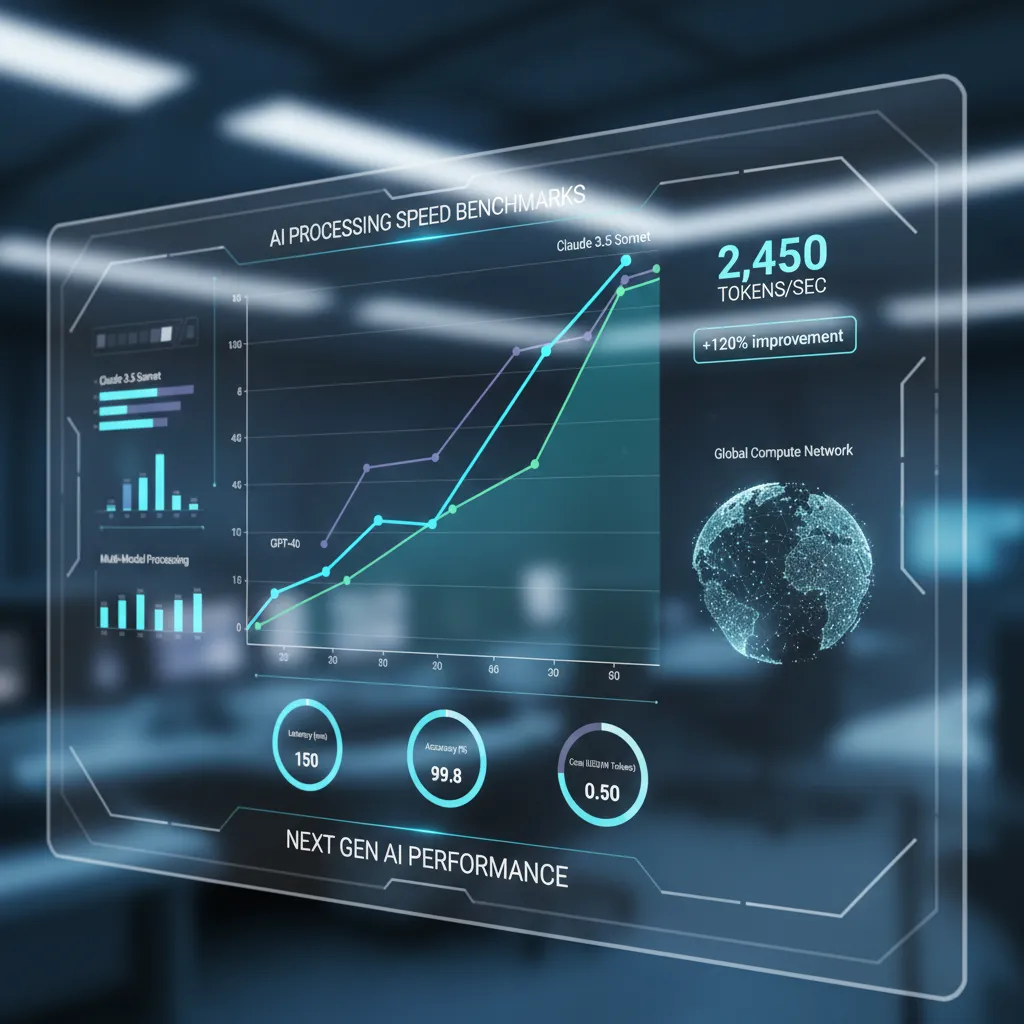
The most compelling aspect of Sonnet’s release is its speed. Anthropic emphasized that the model is roughly twice as fast as its predecessor, Claude 3 Opus, while also being significantly more capable. This speed increase drastically lowers the cost of using the model in scenarios requiring high-volume interaction or quick turnover, pushing it firmly into the territory of the fastest AI model available at its capability tier.
| Metric | Claude 3.5 Sonnet | GPT-4o | Advantage |
|---|---|---|---|
| Performance Tier | Flagship-level (despite being “Sonnet”) | Flagship-level | Parity |
| Speed (Inference) | Extremely fast; 2x faster than Claude 3 Opus | Fast; optimized for speed | Claude 3.5 Sonnet (Claimed) |
| Visual Reasoning | State-of-the-art; excels in complex charts | Excellent | Claude 3.5 Sonnet (Claimed) |
| Cost | Highly competitive Claude 3.5 Sonnet pricing | Highly competitive | Claude 3.5 Sonnet often offers better cost-performance ratio. |
For developers prioritizing low latency and high throughput, the Sonnet 3.5 architecture is a massive leap forward.
Claude 3.5 Artifacts: Revolutionizing the User Experience
While raw benchmark scores captivate researchers, the feature that truly defines the user experience and developer interaction is Claude 3.5 Artifacts. This innovative workspace changes the relationship between user and AI output.
The Interactive Workspace
Traditional generative AI outputs are passive: you ask a question, the AI provides an answer in a text block, and you copy it to another application (like a code editor, design tool, or document).
Artifacts transforms this. When the AI generates content—be it a snippet of code, a graphical representation of data, a document outline, or a design mockup—it appears in a dedicated, dynamic workspace alongside the chat interface.
How Claude 3.5 Artifacts Enhances Workflow:
- Live Interaction: If the AI generates Python code, you can see the execution output or a preview of a generated website directly in the Artifacts window.
- Iteration and Refinement: You can point to a section of the generated artifact (e.g., a specific line of code or a chart element) and ask Claude to modify it, keeping the process self-contained.
- Project Management: It allows for the co-creation of complex projects, moving beyond simple AI content creation to collaborative development.
For an AI for developers, Artifacts is a game-changer. It mirrors the experience of pair programming in a dedicated IDE, making the model incredibly effective for debugging, rapid prototyping, and software engineering.

Deep Dive into Core Capabilities
To fully appreciate why Sonnet 3.5 is shaking up the ecosystem, we need to examine its specific strengths across different domains.
1. Superior AI Coding Assistant Capabilities
The coding proficiency of Claude 3.5 Sonnet is a clear competitive priority for Anthropic.
It exhibits high levels of performance in:
- Complex Function Generation: Producing high-quality, production-ready code in multiple languages (Python, JavaScript, Go, Rust).
- Legacy Code Refactoring: Understanding and updating older, poorly documented codebases with greater accuracy than previous models.
- Security Analysis: Identifying subtle bugs and security vulnerabilities, moving the model into the realm of advanced security and quality assurance (QA) AI tools.
The combination of its reasoning power and the Artifacts workspace means developers can ask, “How can I make this function more memory-efficient?” and immediately see the revised code and potentially a performance graph comparing the two versions—all without leaving the Anthropic API or web interface.
2. Unparalleled Visual Reasoning AI
The advances in AI vision capabilities are critical for enterprises dealing with unstructured visual data.
Consider these powerful Claude 3.5 Sonnet use cases:
- Financial Document Processing: Analyzing dense spreadsheets, financial reports, or images of receipts, understanding the spatial relationships between headers and numerical values.
- Healthcare and Science: Interpreting medical imagery (e.g., X-rays, scans) or detailed biological diagrams, providing sophisticated natural language processing descriptions and summaries.
- Business Intelligence: Extracting data from dashboards and generating narratives about trends identified in those charts, essentially automating the report generation process.
The model isn’t just “seeing” pixels; it’s understanding the semantic SEO context of the visual data. It can infer causal relationships from a scatter plot or pinpoint an anomaly in a bar graph, demonstrating sophisticated visual reasoning AI.

3. Ethical and Safety Alignment
Anthropic built its foundation on responsible AI development. Even with this massive jump in capability and speed, the safety guardrails remain central to the architecture.
The Sonnet 3.5 release maintains Anthropic’s commitment to constitutional AI, striving to make the model less likely to generate harmful, biased, or inappropriate outputs. This adherence to safety standards is crucial for large organizations that need to navigate complex regulatory environments.
[Related: Navigating AI Ethics, Governance, Bias, and Trust in the AI Era]
Implementation and Economics: Sonnet vs Opus and the API
For those integrating Anthropic’s models into commercial products, the economics are just as important as the benchmarks. Claude 3.5 Sonnet pricing is one of its most attractive aspects, positioning it as an incredibly high-value model.
Strategic Positioning: Sonnet Takes the Mid-Flagship Spot
With the release of 3.5 Sonnet, the Anthropic model lineup has effectively shifted:
- Claude 3.5 Sonnet: The new workhorse. It offers capability surpassing the old Opus model at a cost structure far lower than the original Opus and competitive with other mid-tier models. This is the ideal choice for high-volume tasks, complex chat applications, and most general AI in business use cases.
- Claude 3 Opus: The original flagship remains highly capable but is now effectively succeeded in performance by 3.5 Sonnet. Users are encouraged to transition their high-value, but lower-volume, tasks to the new model.
- Claude 3 Haiku: Remains the speed-optimized, most affordable option for simple, high-speed tasks where peak reasoning power is not required (e.g., classifying short messages).
Understanding Claude 3.5 Sonnet Pricing
Anthropic has structured the pricing to reward speed and efficiency. Compared to the former Claude 3 Opus, the 3.5 Sonnet offers:
- Lower Input Costs: The cost per token for input (prompting the model) is reduced, making large context windows more economical.
- Lower Output Costs: The cost per token for output (the generated response) is also highly competitive.
- Higher Throughput: Since the model is faster, developers can process more requests per minute (RPMs) for the same infrastructure cost, drastically improving the ROI of AI for developers.

This aggressive pricing strategy, coupled with flagship-level performance, makes Sonnet 3.5 a compelling choice for organizations looking to optimize their Anthropic API access expenditure without sacrificing quality.
Advanced Use Cases for Enterprise Innovation
The combination of speed, intelligence, and the Artifacts feature unlocks powerful new Claude 3.5 Sonnet use cases across various industries.
1. Financial Analysis and Risk Modeling
Financial institutions require models that can rapidly digest massive amounts of data and perform complex mathematical operations.
- Loan Underwriting: Sonnet can analyze applicant documents (visuals of pay stubs, bank statements) and compare them against regulatory guidelines faster and more accurately than previous models.
- Market Sentiment Analysis: Its speed allows real-time processing of news feeds and social media data, providing instant natural language processing insights for high-frequency trading decisions.
- [Related: AI-Powered Investing: Robo-Advisors and Wealth Growth]
2. Legal and Regulatory Compliance
In the legal world, time is money, and accuracy is non-negotiable.
- Contract Drafting and Review: Using the Artifacts feature, a legal professional can ask Sonnet to draft a clause, review the generated text in the workspace, and immediately command revisions until the compliance threshold is met.
- E-Discovery: Rapidly sifting through vast troves of text and visual evidence (e.g., scanned documents, emails), identifying key legal concepts and generating summaries.
3. Software Development and Engineering
For software teams, Claude 3.5 Sonnet functions as a full-time, highly efficient pair programmer.
- Full Stack Prototyping: Developers can use Artifacts to generate not just isolated functions, but entire front-end components or full-stack application blueprints, seeing the visual result instantly.
- Test Case Generation: Sonnet’s superior reasoning helps it create more robust and edge-case covering unit tests and integration tests, crucial for modern development pipelines.
4. Interactive Education and Training
The model’s ability to handle complex reasoning and provide interactive outputs (via Artifacts) makes it a powerful educational tool.
- Personalized Learning Environments: Building custom tutors that can analyze a student’s work (e.g., an image of their handwritten math homework) and provide targeted, multi-step feedback.
- Simulation Creation: Generating complex simulations or interactive data visualizations that help users learn difficult concepts.
The Future of AI: What Sonnet 3.5 Tells Us
The release of Claude 3.5 Sonnet fundamentally alters the landscape of intelligent systems. It demonstrates a crucial trend: the gap between the fastest, most economical models (like Haiku) and the most powerful models (like Opus/GPT-4) is rapidly closing.
Sonnet 3.5 has effectively commoditized flagship performance. You no longer have to pay a premium price for top-tier reasoning and visual skills; you can access them at scale through a highly optimized, high-speed architecture.
Convergence of Speed and Intelligence
This convergence suggests that future AI models will not necessarily be defined by pure, brute-force scale, but by efficient architecture and specific domain expertise. Anthropic is betting on speed and interactive utility, which is a powerful message to developers building the next generation of applications.
As machine learning continues its exponential growth, models like 3.5 Sonnet will push us toward ambient, real-time AI assistance—where latency is negligible, and the AI feels truly integrated into the user’s workflow, especially through tools like Artifacts.
[Related: The AI Tool Comparison: Finding the Right LLM for Your Business]
Conclusion: The New Standard is Set
The answer to the question, “Is Claude 3.5 Sonnet: The New AI Speed King?” appears to be a resounding yes, at least for the mid-to-high-tier category. Anthropic has successfully blended state-of-the-art reasoning and unparalleled AI vision capabilities with optimized speed and highly competitive Claude 3.5 Sonnet pricing.
For developers, its superior performance as an AI coding assistant and the revolutionary workflow facilitated by the Artifacts feature make it an immediate must-evaluate model. For businesses, its speed and cost-effectiveness mean the barriers to leveraging advanced generative AI at scale have never been lower.
The race between Anthropic and other major players is accelerating. Claude 3.5 Sonnet is not just a participant; it’s an accelerator, setting the new benchmark for speed, capability, and interactive design in the future of AI.
To truly harness the power of this new model, start experimenting with the Artifacts workspace today and see how this new large language model can transform your development or content creation workflow.
FAQs
Q1. What is Claude 3.5 Sonnet and how does it compare to its predecessors?
Claude 3.5 Sonnet is Anthropic’s latest flagship-tier large language model. While positioned in the “Sonnet” family (historically the mid-tier), its performance significantly surpasses the previous flagship model, Claude 3 Opus, in key areas like coding, visual reasoning, and overall speed. It is designed to be highly capable, extremely fast, and cost-effective.
Q2. Is Claude 3.5 Sonnet faster than GPT-4o?
Anthropic claims that Claude 3.5 Sonnet is approximately twice as fast as the previous Claude 3 Opus model. While speed comparisons depend heavily on the specific task and infrastructure, Claude 3.5 Sonnet is aggressively optimized for speed and low latency, making it a strong contender for the title of the fastest AI model in the high-capability category, often offering better throughput than GPT-4o for complex tasks.
Q3. What is the “Artifacts” feature in Claude 3.5?
Claude 3.5 Artifacts is an innovative, interactive workspace where the outputs generated by the AI model—such as code, documents, charts, or design mockups—are displayed and can be edited live by the user. It allows for a real-time, iterative co-creation experience, transforming the model into a highly effective AI coding assistant and project partner.
Q4. How good is Claude 3.5 Sonnet for coding and software development?
Claude 3.5 Sonnet has demonstrated significant gains in its coding abilities, performing exceptionally well on standard benchmarks like HumanEval. It excels at generating complex, clean code, debugging legacy systems, and aiding in security analysis. Its combination of strong code reasoning and the interactive Artifacts feature makes it one of the best AI for coding currently available.
Q5. What are Claude 3.5 Sonnet’s main AI vision capabilities?
Claude 3.5 Sonnet boasts world-class AI vision capabilities, particularly strong in visual reasoning AI. It is highly adept at interpreting complex visual data, including dense charts, detailed graphs, technical diagrams (like architectural blueprints), and images containing handwritten text, providing accurate descriptions and data extraction for use cases like financial and engineering analysis.
Q6. Can I access Claude 3.5 Sonnet via an API, and what is the pricing like?
Yes, Claude 3.5 Sonnet API access is immediately available for developers. The Claude 3.5 Sonnet pricing is highly competitive and structured for efficiency, offering a superior cost-to-performance ratio compared to the previous Opus model and often undercutting competitors for similar performance levels, making it ideal for scaling AI in business.
Q7. What is the key difference between Claude 3.5 Sonnet and the previous flagship, Claude 3 Opus?
Claude 3.5 Sonnet is a complete architectural refresh that is significantly faster (around 2x) and more capable across benchmarks, especially in coding and vision, than Claude 3 Opus. While Opus was the original flagship, Sonnet 3.5 effectively replaces it as Anthropic’s new, higher-performing, and more efficient default model for high-value applications.