Wanderlust AI: How AI is Revolutionizing Personalized Travel Planning

Introduction
Remember the old way of planning a vacation? It was a digital treasure hunt spread across a dozen browser tabs. One for flights, three for hotels, a handful for “best restaurants in Rome,” and a few more for debating whether that one obscure museum was really worth the trek. The result was often a Franken-itinerary—a stitched-together plan that felt more generic than personal, cobbled from the same top-10 lists everyone else was using.
That era is fading fast. We are now at the forefront of a travel revolution, powered by the same technology that curates our playlists and recommends our next binge-watch: Artificial Intelligence. The future of travel AI is here, and it’s not about chatbots that can’t understand your accent. It’s about sophisticated AI travel planner systems that act as your personal concierge, data analyst, and globetrotting best friend, all rolled into one.
This is the age of the personalized travel itinerary, a world where your vacation is no longer a pre-packaged product but a bespoke experience crafted around your unique desires, budget, and travel style. In this deep dive, we’ll explore how this travel innovation AI works, uncover the incredible benefits of smart travel planning, showcase the best AI travel apps of 2024, and gaze into the crystal ball of future travel technology. Get ready for a new era of AI powered adventures.
Beyond the Search Bar: What Exactly is an AI Travel Planner?
At its core, an AI travel planner is far more than a simple search engine. While Google can find you a list of hotels, a digital travel assistant understands the context of your trip. It’s the difference between being handed a phone book and having a local guide who knows your tastes.
These platforms leverage a powerful cocktail of technologies:
- Machine Learning (ML): This is the engine of personalization. The more you interact with the
AI vacation planner, the better it understands your preferences. It learns whether you prefer boutique hotels over big chains, street food over fine dining, or historical sites over hiking trails. - Natural Language Processing (NLP): This allows you to communicate with the AI in plain English. Instead of typing “hotels Paris budget <$200,” you can say, “Find me a charming, budget-friendly hotel in a quiet Parisian neighborhood for my anniversary trip.”
- Predictive Analytics: By analyzing vast datasets—historical flight prices, weather patterns, crowd density at tourist spots—the AI can make intelligent suggestions. It might advise you to book your Japan trip in late October for the best autumn foliage with fewer crowds or suggest an alternative flight route that’s historically cheaper and less prone to delays.
This combination allows an AI trip organizer to move beyond simple booking aggregation and into the realm of true automated travel planning, creating customized travel experiences that feel uniquely yours.
The Magic Behind the Map: How AI Crafts Your Perfect Trip
So, how does an AI itinerary generator actually transform your vague travel dreams into a concrete, day-by-day plan? The process is a fascinating blend of user input and immense data processing.
Step 1: Understanding You - The Power of Personalization
It all starts with you. A modern AI travel assistant will typically begin with a conversational prompt or a detailed questionnaire. It goes beyond the basic “where and when.”
- Who are you traveling with? (Solo, couple, family with young kids)
- What’s your pace? (Action-packed, relaxed, or a mix)
- What are your interests? (Art, history, food, nature, nightlife, adventure sports)
- What’s your budget? (Backpacker, mid-range, luxury)
- What’s your travel style? (Off-the-beaten-path, iconic landmarks, local immersion)
This initial data feed is crucial. It sets the parameters for the AI, ensuring the recommendations are tailored for AI for personalized trips, not for a generic tourist. This is the essence of AI for bespoke travel.
Step 2: The Data Dive - AI’s Information Synthesis
Once the AI understands your profile, it begins its monumental task: synthesizing billions of data points in seconds. This includes:
- Logistics: Real-time flight prices and schedules from countless airlines.
- Accommodation: Availability, pricing, and amenities from hotels, vacation rentals, and hostels.
- Activities: Opening hours, ticket prices, and booking availability for museums, parks, and tours.
- Reviews & Sentiment: Analyzing thousands of reviews from blogs, travel sites, and social media to gauge the true quality of a place, filtering out fake reviews and understanding the nuance.
- Contextual Data: Factoring in local holidays, weather forecasts, traffic patterns, and even public transit schedules.
This is where the machine learning travel algorithms shine, finding patterns and connections a human researcher could easily miss.
Step 3: Building the Blueprint - The Smart Trip Builder
With all this data, the smart trip builder begins to assemble your itinerary. It doesn’t just list places; it sequences them logically. It understands that you shouldn’t book a museum on the one day of the week it’s closed or plan a long walk during a predicted afternoon thunderstorm.
The system focuses on creating AI optimized routes, clustering activities by neighborhood to minimize travel time and maximize your experience. Instead of zig-zagging across a city, you’ll have a fluid plan that flows naturally from one point of interest to the next.

For example, a day in Paris might start at the Louvre, followed by a stroll through the nearby Tuileries Garden, and end with dinner in the adjacent Saint-Germain-des-Prés district—all seamlessly connected.
Step 4: Real-Time Adaptation & On-the-Go Assistance
Perhaps the most revolutionary aspect of a true AI travel assistant is its ability to adapt. Traditional travel plans are static. If a train strike paralyzes the city or your much-anticipated restaurant has a sudden plumbing issue, your plans are thrown into chaos.
An AI planner, however, can be dynamic. Connected to real-time data, it can:
- Alert you to a flight delay and suggest alternative routes.
- Find a comparable, highly-rated restaurant nearby if your first choice closes unexpectedly.
- Suggest an indoor activity, like a gallery visit, if it suddenly starts to rain.
This turns your itinerary from a rigid script into a living, breathing document that flexes with the unpredictability of travel. Related: Apple Intelligence: Top AI Features in iOS 18 Guide
More Than an Itinerary: The Tangible Benefits of Smart Travel Planning
Adopting an AI vacation organizer isn’t just a novelty; it delivers real, measurable benefits that fundamentally change how we explore the world.
Hyper-Personalization at Scale
The core promise of travel tech AI is a trip that feels like it was made just for you. An AI recommendations travel engine can create two completely different itineraries for two different people visiting the same city.
- The History Buff in Rome: Their itinerary is packed with visits to the Roman Forum, Palatine Hill, private tours of the Vatican’s hidden archives, and dinner at restaurants known for recreating ancient Roman recipes.
- The Fashionista in Rome: Their plan includes appointments at bespoke tailors, a tour of the Gucci and Fendi flagship stores, a visit to artisan leather workshops, and reservations at the city’s trendiest rooftop bars.
This level of detail creates deeply meaningful and customized travel experiences.
Unlocking Efficiency and Saving Time
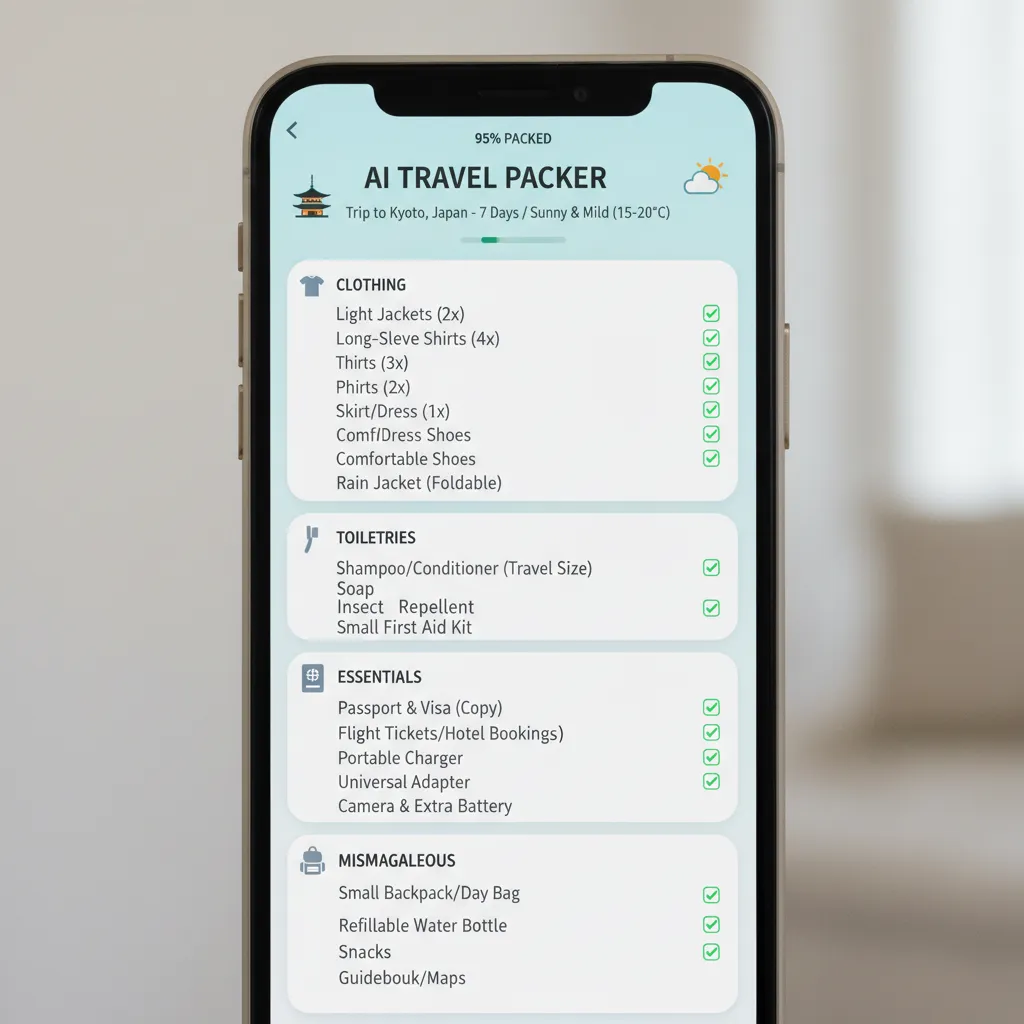
The most immediate benefit is reclaiming your time. The average person can spend 10-20 hours, sometimes more, planning a multi-day trip. An AI can produce a detailed, well-researched first draft in minutes. This frees you up to focus on the exciting parts of travel, not the logistical headaches. The efficiency extends to all areas, even generating smart packing lists based on your destination’s weather and planned activities.
Mastering Your Money: AI for Budget Travel
For many, budget is the biggest constraint. AI budget travel tools are a game-changer. They can:
- Track & Predict Prices: Alert you when flight prices are likely to be at their lowest.
- Find Value Alternatives: Suggest a slightly less-touristy neighborhood with equally good hotels at half the price.
- Optimize Spending: Build an itinerary that balances big-ticket items with free activities like parks and walking tours.
- Bundle Deals: Identify opportunities to save by booking flights and hotels together.
This financial intelligence ensures you get the most out of every dollar. Related: AI in Finance: The Future of Money & Personal Wealth
Discovering Hidden Gems
Top-10 lists often create tourist bottlenecks, sending everyone to the same handful of spots. AI excels at breaking this cycle. By analyzing geo-tagged photos on social media, reviews on niche blogs, and mentions in local forums, it unearths hidden gems—the family-run trattoria with no sign, the secluded beach, the quirky independent bookstore—that you would never find in a standard guidebook. This leads to truly AI powered adventures.
The Class of 2024: The Best AI Travel Apps and Tools on the Market
The AI and tourism landscape is exploding with innovative tools. While the “best” app depends on your specific needs, here are some of the leading AI travel tools 2024 that are defining the market.
| Tool | Key Features | Best For | Quick Takeaway |
|---|---|---|---|
| Wanderlog | Collaborative planning, budget tracking, flight/hotel import, map-based itinerary. | Groups and meticulous planners who love seeing everything on a map. | A powerful, all-in-one AI trip organizer that excels at logistics and group coordination. |
| TripIt | Automatically creates a master itinerary from confirmation emails (flights, hotels, cars). | Business travelers and anyone juggling multiple bookings. | The undisputed king of automated travel planning for organizing existing reservations. |
| GuideGeek (via WhatsApp) | Conversational AI planner that works through a simple chat interface. | Quick suggestions and on-the-go planning without downloading a new app. | An incredibly accessible AI travel assistant that feels like texting a knowledgeable friend. |
| Curiosio | Focuses on complex road trips, suggesting routes based on interests, time, and budget. | Road trippers and adventurers looking for unique, multi-stop journeys. | The best AI itinerary generator for planning epic drives and discovering points of interest along the way. |
| ChatGPT / Gemini | General-purpose AI that can generate detailed itinerary ideas with specific prompts. | Brainstorming, getting initial ideas, and creating text-based plans. | A flexible starting point, but requires manual fact-checking and booking. |
The Road Ahead: The Future of Travel AI and Tourism
What we’re seeing now is just the beginning. The future of travel AI promises a level of integration and assistance that sounds like science fiction but is rapidly becoming reality.
Predictive and Proactive Assistance
Imagine your digital travel assistant monitoring your journey proactively. It detects your first flight is delayed by an hour, automatically calculates you’ll miss your connection, and rebooks you on the next available flight—all before you’ve even landed. It then notifies your hotel of your new arrival time and sends an updated transfer voucher to your phone. This is the future of stress-free travel.
Sustainable and Conscious Travel
As travelers become more environmentally conscious, AI will play a crucial role in promoting sustainability. Future AI travel tools will:
- Calculate and display the carbon footprint of different travel options.
- Recommend eco-certified hotels and tour operators.
- Promote
AI optimized routesthat utilize public transport or electric vehicles. - Guide tourists towards supporting local artisans and businesses to ensure tourism dollars benefit the community directly.

This shift represents a powerful application of AI driven tourism for positive impact. Related: Decentralized Science: How Blockchain & AI Fuel a Research Revolution
Augmented Reality and Immersive Experiences
The line between digital information and physical reality will blur. Point your smartphone or future AR glasses at an ancient ruin, and an AI-powered overlay will reconstruct it to its former glory, complete with historical facts and stories. Walk through a market, and your glasses could translate signs and menus in real time. This technology will transform sightseeing from a passive to an interactive, deeply educational experience.

Related: Haptic AI: Feeling the Future of Immersive Digital Experiences
Navigating the Nuances: Limitations and Ethical Considerations
While the potential is immense, it’s important to approach AI holiday planning with a balanced perspective.
- The Spontaneity Factor: Over-planning can kill the magic of discovery. The best trips often have moments of serendipity—getting lost and finding a hidden courtyard or striking up a conversation with a local. It’s crucial to use AI as a guide, not a dictator.
- Data Privacy: These tools require access to a lot of personal data to function effectively. Users must be confident that their information is secure and used ethically.
- Algorithmic Bias: Is the AI recommending a restaurant because it’s genuinely the best, or because it has an affiliate partnership? There’s a risk that AI could favor large chains with bigger data footprints, inadvertently harming smaller, independent businesses.
- The Human Touch: An AI can’t replicate the warmth of a recommendation from a passionate hotel owner or the shared laughter with a local who points you to their favorite coffee shop. Technology should augment, not replace, human connection.
Conclusion
The world of travel planning is undergoing a seismic shift. The days of generic, one-size-fits-all tourism are numbered. The AI travel planner is not just a tool for convenience; it’s a gateway to a new philosophy of travel—one that is deeply personal, incredibly efficient, and endlessly fascinating.
By harnessing the power of smart travel planning, we can spend less time stressed behind a screen and more time experiencing the world in a way that truly resonates with who we are. From crafting the perfect personalized travel itinerary to discovering hidden corners of the globe, travel innovation AI is empowering a new generation of explorers. The journey ahead is not just about where we go, but about the unique, intelligent, and inspiring ways we get there.
What’s the first destination you’d plan with an AI travel assistant? Share your dream trip in the comments below!
Frequently Asked Questions (FAQs)
Q1. What is the best AI for planning a trip?
While the “best” is subjective, some of the top-rated AI travel planners in 2024 include Wanderlog for collaborative and map-based planning, TripIt for automatically organizing bookings from emails, and GuideGeek for quick, conversational planning via WhatsApp. The ideal choice depends on whether you need help with brainstorming, logistics, or on-the-go assistance.
Q2. Can AI create a travel itinerary?
Absolutely. This is one of the core functions of an AI travel planner. By providing your destination, dates, interests, and budget, an AI itinerary generator can produce a detailed, day-by-day plan complete with activity suggestions, restaurant recommendations, and logically optimized routes to save you time.
Q3. Is there a free AI trip planner?
Yes, many AI travel tools offer robust free versions. Apps like Wanderlog and TripIt have free tiers that are very powerful. General AI tools like ChatGPT and Google Gemini can also be used for free to generate detailed itinerary ideas, though they require you to handle the booking and verification yourself.
Q4. How does an AI travel planner work?
An AI travel planner works by collecting your personal travel preferences (like budget, interests, and pace) and then processing massive amounts of real-time data from the internet. Using machine learning and predictive analytics, it synthesizes flight schedules, hotel availability, reviews, maps, and more to build a customized travel experience that is efficient and tailored to you.
Q5. What are the limitations of using AI for travel planning?
The main limitations include a potential loss of spontaneity if you follow the plan too rigidly, concerns over data privacy, and the risk of algorithmic bias towards mainstream or commercially affiliated options. Furthermore, AI cannot yet fully replicate the nuanced, personal recommendations that come from human interaction with locals.
Q6. Can ChatGPT plan a full vacation?
ChatGPT and other large language models are excellent tools for brainstorming and creating a detailed, text-based travel plan. You can ask it to create a 7-day itinerary for Italy for a foodie on a mid-range budget, and it will give you a fantastic starting point. However, it cannot access real-time pricing or availability, so you will need to manually verify all details (like opening hours) and book everything yourself.