AI Reshapes Code: How AI is Revolutionizing Software Development

Introduction
Software development has always been a story of evolution. From assembly language to high-level programming, each paradigm shift has unlocked new levels of productivity and complexity. Today, we stand at the precipice of the most significant transformation yet: the integration of Artificial Intelligence into the very fabric of coding. This isn’t a distant sci-fi concept; AI software development is the new reality, fundamentally altering how we design, write, test, and deploy applications.
For developers, this marks a pivotal moment. The conversation is shifting from writing lines of code to solving problems at a higher level, with AI acting as a powerful collaborator. For businesses, it means unprecedented speed, efficiency, and the potential for greater AI for software innovation.
This comprehensive guide explores the profound ways AI is transforming coding. We’ll journey through the entire software development lifecycle to see how AI is making its mark, from initial planning to final deployment. You’ll learn about the cutting-edge AI coding tools available today, understand how AI helps developers become more productive, and gain insight into the future of software engineering in an AI-driven world. Whether you’re a seasoned developer, a tech leader, or simply curious about the next wave of technological change, this article will illuminate the revolution that’s already underway.
The Dawn of a New Era: What is AI-Assisted Coding?
At its core, AI assisted coding is the use of artificial intelligence and machine learning models to help human developers with various programming tasks. It’s not about replacing the developer but augmenting their abilities, much like a calculator enhances an accountant’s speed and accuracy. The most prominent force in this domain is Generative AI for developers, powered by large language models (LLMs) trained on billions of lines of public code, documentation, and text.
These aren’t simple autocomplete systems. Modern AI programming assistants can:
- Generate Code Snippets: Write entire functions or classes based on a simple natural language comment.
- Translate Languages: Convert code from one programming language to another (e.g., Python to JavaScript).
- Explain Complex Code: Break down a complicated function and explain what it does in plain English.
- Identify Bugs: Analyze code for potential errors and suggest fixes before it’s even run.
Tools like GitHub Copilot, Amazon CodeWhisperer, and Tabnine are leading this charge, integrating seamlessly into AI powered IDEs (Integrated Development Environments) like VS Code and JetBrains. They act as a “pair programmer,” constantly offering suggestions, completing lines, and reducing the mental load of writing boilerplate code. This frees developers to focus on higher-level logic, architecture, and creative problem-solving.
[Related: What is GPT-4o? OpenAI’s New AI Explained]
Revolutionizing the Software Development Lifecycle (SDLC) with AI
AI’s influence isn’t confined to just writing code; it’s weaving itself into every stage of the software development lifecycle (SDLC), making each phase smarter, faster, and more efficient. Let’s break down how this AI transformation is taking shape.
1. AI in Planning and Design: From Idea to Blueprint
Before a single line of code is written, AI is helping to lay a stronger foundation. In the planning phase, AI tools can analyze market data and user feedback to identify key features for a new application. In the design phase, Low code no code AI platforms enable product managers and even non-technical stakeholders to create interactive prototypes, accelerating the feedback loop and ensuring the final product aligns with user needs.
Furthermore, AI can assist in architectural design by simulating different system models to predict performance bottlenecks, suggest optimal database schemas, or ensure scalability, promoting a more robust and forward-thinking approach to AI and agile development.
2. Accelerated Code Generation: The Rise of AI Programming Assistants
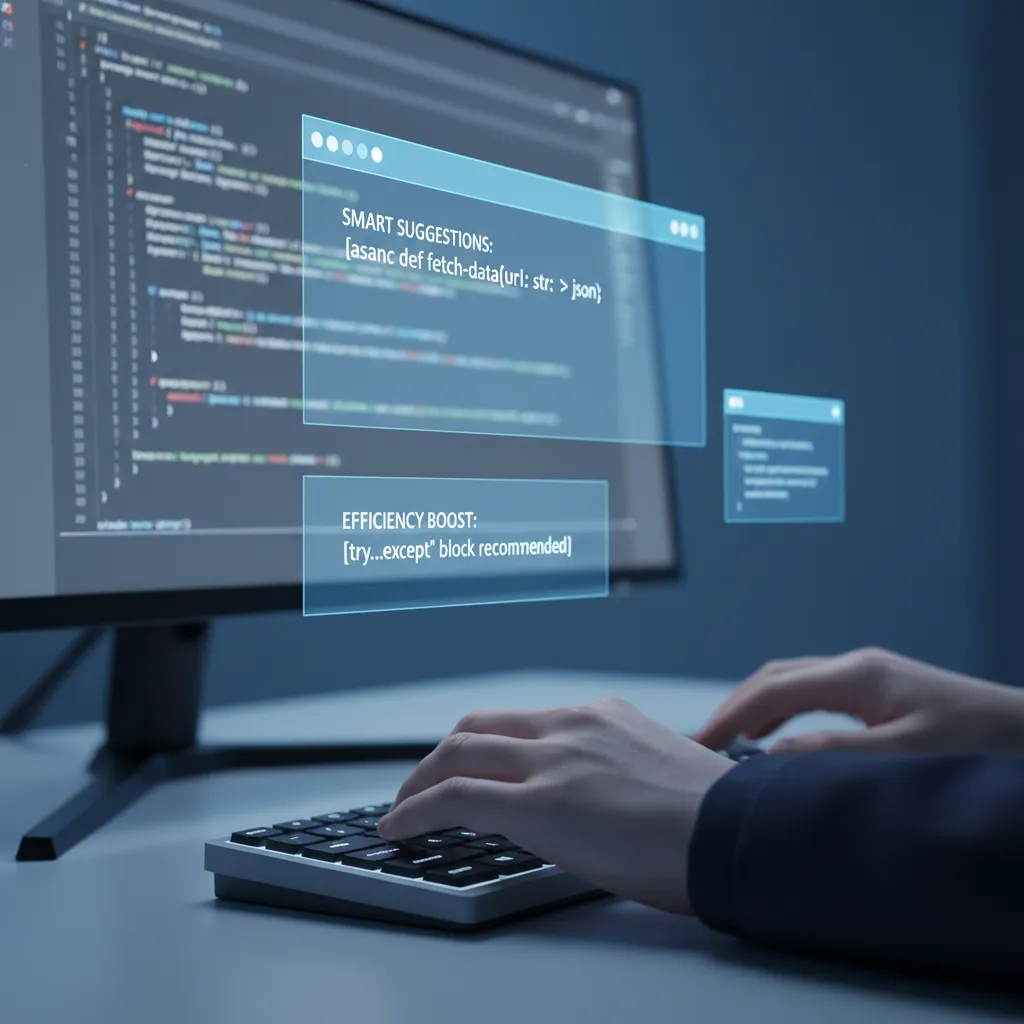
This is where generative AI shines the brightest. AI code generation has moved from a novelty to a daily driver for millions of developers, drastically improving AI and dev productivity. Instead of manually typing out a common function to parse a JSON file or make an API call, a developer can simply write a comment describing their intent.
For example, a Python developer could write:
# function to fetch user data from /api/users/{id} and handle errors
An AI coding tool like GitHub Copilot would then instantly suggest the complete function, including the try-except block for error handling and proper API request formatting. This massively reduces time spent on repetitive tasks, minimizes typos, and helps developers learn new libraries or language features on the fly. This boost to AI productivity for coders allows teams to focus their energy on building unique, value-driven features.
3. Intelligent Debugging and Error Resolution
Debugging is famously one of the most time-consuming aspects of programming. It’s a detective story where the clues are buried in stack traces and log files. AI for debugging code is changing the narrative by turning the AI into a master detective.
Modern AI developer tools can:
- Analyze Errors: When an application crashes, AI can analyze the error message and stack trace, cross-reference it with vast datasets of known issues, and often pinpoint the exact line causing the problem.
- Suggest Fixes: Beyond just identifying the error, AI can propose concrete code changes to resolve it.
- Predict Potential Bugs: Using static analysis, machine learning in software can scan codebases to identify “code smells” or patterns that are likely to lead to bugs in the future, even if they aren’t causing problems now.
This proactive and intelligent approach to debugging transforms a frustrating process into a more streamlined and educational experience.
4. AI-Driven Software Testing: Enhancing Quality and Speed
A robust testing suite is the backbone of reliable software, but creating and maintaining it is a monumental effort. AI driven software testing is automating and optimizing this critical phase to ensure higher quality releases.
AI tools are being deployed to:
- Generate Test Cases: AI can analyze the application’s code and user interface to automatically generate meaningful test cases, covering edge cases that human testers might miss.
- Automate UI Testing: Instead of writing brittle scripts to test a user interface, AI can visually analyze the application, understand its components (buttons, forms), and intelligently navigate it like a human user would.
- Optimize Test Execution: AI can predict which tests are most relevant to run based on recent code changes, saving valuable time and computational resources in the CI/CD pipeline.
[Related: Mastering AI Workflows for Productivity and Automation]
5. Automated Code Reviews and Quality Assurance
Code reviews are essential for maintaining code quality, sharing knowledge, and mentoring junior developers. However, they can be a bottleneck. Automated code review AI acts as a first line of defense, freeing up senior engineers to focus on more complex architectural and logical issues.
These tools can automatically scan pull requests for:
- Security Vulnerabilities: Identifying common security flaws like SQL injection or cross-site scripting.
- Style Inconsistencies: Ensuring the code adheres to the team’s established formatting and style guidelines.
- Performance Issues: Flagging inefficient code, such as loops that could be optimized or redundant database queries.
- Best Practice Violations: Catching anti-patterns or deviations from established best practices for a given language or framework.
This automated pre-screening ensures that by the time a human reviewer sees the code, the most common issues have already been addressed.

6. Streamlining DevOps and Deployments
DevOps is all about bridging the gap between development and operations to deliver software faster and more reliably. AI in DevOps, often called AIOps, is the next evolution of this practice.
AI is being used to:
- Predict Deployment Failures: By analyzing historical deployment data, AI can flag a new release that has a high probability of causing issues in production.
- Optimize Infrastructure: AI can automatically scale cloud resources up or down based on real-time traffic patterns, optimizing costs and performance.
- Intelligent Log Analysis: Instead of having engineers manually sift through millions of log entries, AI can detect anomalies and surface critical errors automatically, reducing mean time to resolution (MTTR).
The Bigger Picture: AI’s Strategic Impact on Software Engineering
The changes AI brings are more than just tactical improvements; they represent a strategic shift in how we approach technology and talent.
Modernizing Legacy Systems with AI
Many large organizations are weighed down by decades-old legacy codebases that are expensive to maintain and difficult to update. AI for legacy code modernization offers a lifeline. Specialized AI tools can now perform tasks that were previously prohibitively complex, such as:
- Code Translation: Automatically translating code from outdated languages like COBOL to modern ones like Java or Python.
- Documentation Generation: Analyzing undocumented code and generating clear, human-readable documentation.
- Dependency Mapping: Untangling complex dependencies within a monolithic application to help plan its decomposition into microservices.
This capability unlocks immense value trapped in legacy systems, allowing enterprises to become more agile and innovative.
[Related: AI Transforms Education: Future-Proofing Your Skills]
The Impact on Developer Roles and Coding Jobs
The most pressing question for many is the AI impact on coding jobs. The fear of replacement is understandable, but the reality is shaping up to be one of evolution. AI is unlikely to replace developers; it will replace the tedious aspects of their jobs.
The role of the software engineer is elevating. The emphasis is shifting from being a “code writer” to being a “problem solver” and “system architect.” Developers who embrace AI will be able to:
- Operate at a Higher Level of Abstraction: Focusing on system design, user experience, and business logic while AI handles the low-level implementation details.
- Become 10x Engineers: Using AI to amplify their output, building and iterating on complex systems faster than ever before.
- Focus on Creativity and Innovation: With mundane tasks automated, developers have more cognitive bandwidth for creative solutions and true innovation.
The future proof developer skills will be less about memorizing syntax and more about critical thinking, system design, prompt engineering, and the ability to effectively guide and collaborate with AI tools.
Ethical Considerations and Challenges in AI Development
With great power comes great responsibility. The rise of AI in programming is not without its challenges. It’s crucial to address the ethical AI in development to ensure this technology is used responsibly. Key concerns include:
- Code Bias and Security: AI models are trained on public code, which can contain biases and security vulnerabilities. Using AI-generated code without critical review can introduce these flaws into your application.
- Intellectual Property: The legal landscape around code generated by AI trained on open-source repositories is still evolving, raising questions about ownership and licensing.
- Over-Reliance and Skill Atrophy: Junior developers, in particular, must be careful not to become overly reliant on AI tools, ensuring they still build a strong fundamental understanding of programming principles.
[Related: AI Privacy On-Device: Securing Your Data]
Getting Started: The Best AI Coding Tools for Developers in 2025
The market for AI developer tools is exploding. While there are many options, a few stand out as leaders in the current landscape of AI in enterprise software and individual development.
| Tool | Key Strength | Ideal User |
|---|---|---|
| GitHub Copilot | Deep integration with IDEs, high-quality suggestions, powered by OpenAI. | General-purpose developers across all languages. |
| Amazon CodeWhisperer | Excellent for AWS development, security scanning, reference tracking for attribution. | Developers working within the AWS ecosystem. |
| Tabnine | Focus on privacy (can be self-hosted), personalized models for teams. | Enterprises and developers with strict privacy requirements. |
| Replit AI (Ghostwriter) | Seamless in-browser experience for quick prototyping and learning. | Students, educators, and developers building web apps. |
| Snyk Code | AI-powered security scanning that finds and helps fix vulnerabilities in real-time. | Security-conscious developers and DevOps teams. |
Choosing the best AI for coding often depends on your specific workflow, technology stack, and priorities—whether it’s raw generation power, security, or privacy.

Conclusion
The revolution is here. AI transforming coding is not a future prediction; it’s the current, rapidly evolving state of the industry. From generating boilerplate code in seconds to predicting production failures before they happen, AI is a powerful partner at every stage of the software lifecycle. This collaboration is leading to a massive surge in AI and dev productivity, enabling teams to build more robust, secure, and innovative software faster than ever before.
The future of software engineering is not one of human versus machine, but human with machine. The developers who thrive will be those who embrace these new AI coding tools, adapt their skills, and leverage AI to amplify their own creativity and problem-solving abilities. The very act of creation is being reshaped, and for those ready to adapt, the possibilities are limitless.
How has AI started to change your coding workflow? Share your favorite tools and experiences in the comments below!
FAQs
Q1. What is AI in software development?
AI in software development refers to the use of artificial intelligence and machine learning techniques to assist or automate tasks throughout the entire software development lifecycle (SDLC). This includes everything from planning and design to code generation, debugging, testing, and deployment.
Q2. Will AI replace software developers?
The overwhelming consensus is no, AI will not replace software developers. Instead, it will augment their capabilities, automating repetitive and tedious tasks. This allows developers to focus on more complex, creative, and strategic work like system architecture, problem-solving, and user experience design, ultimately making them more productive.
Q3. How is AI used in coding?
AI is used in coding primarily through AI-powered programming assistants like GitHub Copilot. These tools integrate into a developer’s code editor to provide real-time suggestions, generate entire functions from natural language comments, translate code between languages, and identify potential bugs before the code is even run.
Q4. What are the benefits of using AI in software testing?
The primary benefits of AI-driven software testing are increased speed, broader coverage, and higher efficiency. AI can automatically generate thousands of test cases, intelligently identify critical areas to test after a code change, and perform visual UI testing, catching bugs earlier and freeing up human testers to focus on more complex exploratory testing.
Q5. What is the best AI for coding?
The “best” AI for coding depends on individual needs. GitHub Copilot is widely regarded as the industry leader for general-purpose code generation. Amazon CodeWhisperer is excellent for developers in the AWS ecosystem. Tabnine is a great choice for teams prioritizing privacy and custom models.
Q6. How does AI help in debugging code?
AI assists in debugging by analyzing error messages and stack traces to suggest the root cause and potential fixes. It can also perform static analysis to proactively identify code patterns that are likely to cause bugs in the future, helping developers write more robust code from the start.
Q7. What are the ethical concerns of AI in programming?
Key ethical concerns include the potential for AI to introduce biases or security vulnerabilities from its training data, issues surrounding intellectual property and licensing of AI-generated code, and the risk of over-reliance on AI tools, which could hinder the skill development of junior programmers.
Q8. How will AI change the future of software engineering?
AI will elevate the role of a software engineer from a simple “coder” to a “system architect” or “AI collaborator.” The future will demand skills in prompt engineering, system design, and the ability to effectively guide AI tools. The speed of innovation will accelerate as developers are freed from mundane tasks to focus on building novel solutions.