AI Music Generation: Composing Tomorrow’s Hits with Artificial Intelligence
The familiar silence of a studio is broken not by the strum of a guitar or the tap of a key, but by the gentle hum of a processor. A simple text prompt—“a soulful blues track about rain in a futuristic city, with a female vocalist”—is entered. Seconds later, a complete, layered, and emotionally resonant piece of music fills the room. This isn’t science fiction; this is the reality of AI music generation in 2024.
For decades, artificial intelligence in music was a niche academic pursuit. Today, it has exploded into the mainstream, with powerful generative AI music tools empowering everyone from seasoned producers to complete beginners to create high-quality audio with unprecedented ease. This technological leap is fundamentally reshaping the future of music production, raising exhilarating possibilities and complex questions in equal measure.
This deep dive explores the revolutionary landscape of artificial intelligence music composition. We’ll demystify how AI makes music, spotlight the best AI music generators available today, and analyze the profound impact of this technology on artists, the industry, and the very nature of creativity. Get ready to discover how the next chart-topping hit might just be composed by a partnership between human and machine.
What is AI Music Generation and How Does It Actually Work?
At its core, AI music generation is the process of using artificial intelligence algorithms to create original musical content. Unlike a simple synthesizer that plays pre-recorded samples, these systems learn the underlying patterns, structures, melodies, rhythms, and harmonies from vast amounts of existing music. They then use this knowledge to generate entirely new compositions.
Think of it like teaching a student an entire library of music theory and letting them listen to every song ever recorded. Eventually, that student can start composing in the style of Beethoven, The Beatles, or a genre that doesn’t even exist yet. That’s the essence of composing with AI, but on a massive, data-driven scale.
The Technology Behind the Tunes: From Algorithms to Art
The magic behind AI song creation isn’t magic at all—it’s a sophisticated blend of computer science and data. The primary technology driving this revolution is music deep learning, a subset of AI that uses neural networks with many layers to analyze complex data.
Here are the key components:
- Neural Networks: These are computer systems modeled on the human brain. They are trained on massive datasets of music, allowing them to recognize everything from chord progressions to instrumental timbres.
- Transformers: This is the same architecture powering language models like ChatGPT. In music, they excel at understanding long-range dependencies—how a note played at the beginning of a song relates to a chord played minutes later. This allows for more cohesive and structured compositions.
- Generative Adversarial Networks (GANs): Imagine two AIs in a creative competition. One AI (the “generator”) creates music, and the other (the “discriminator”) tries to determine if it’s human-made or AI-made. This process forces the generator to create increasingly realistic and high-quality music.
- Text-to-Music AI: This is one of the most exciting AI music trends 2024. Users can input a descriptive text prompt (e.g., “upbeat indie pop for a summer road trip”), and the AI interprets the mood, genre, and instrumentation to generate a corresponding track.
This algorithmic music composition process transforms abstract data into audible art, turning patterns into passion and code into choruses.
The Creative Process: A New Kind of Collaboration
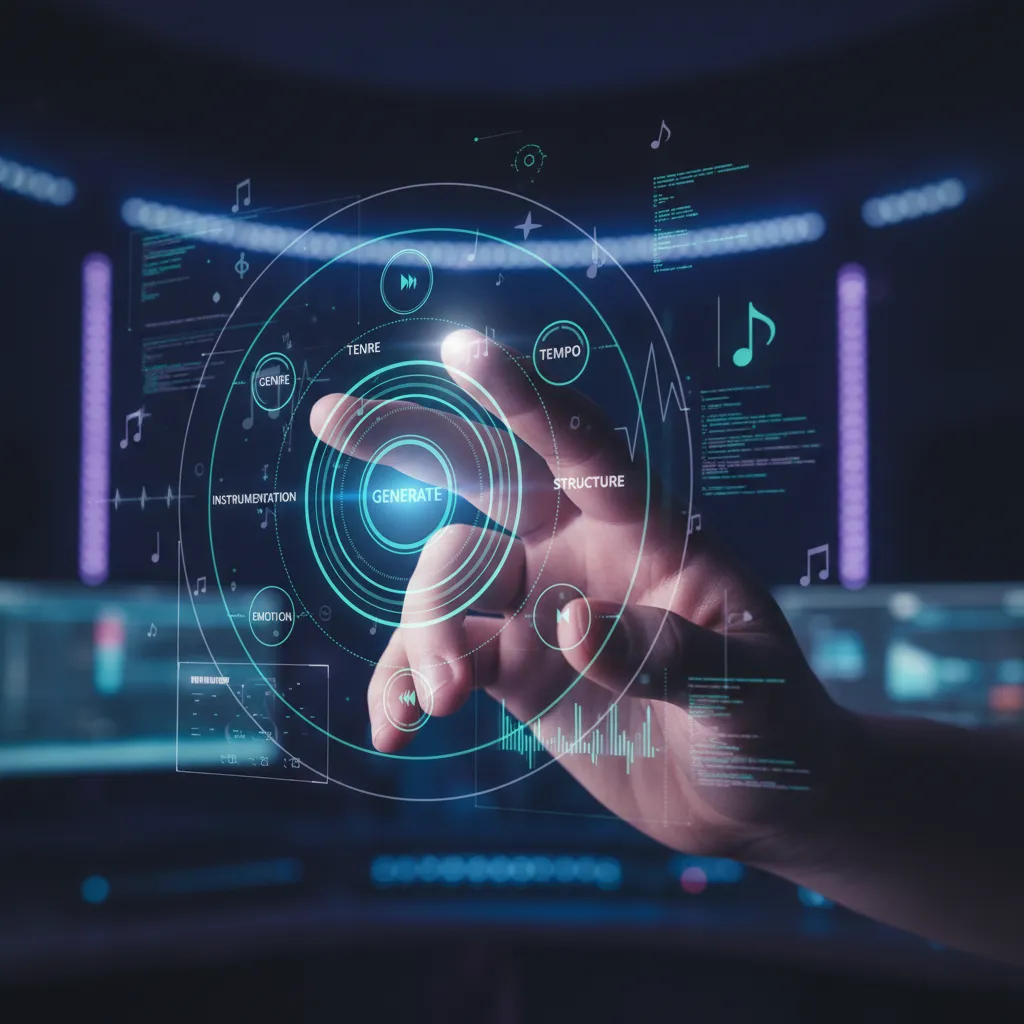
Using an AI music generator is less about pressing a button and more about guiding a creative partner. The user is the director, providing the initial vision and refining the output.
The typical workflow looks something like this:
- Prompting: The user provides a detailed text description, selects a genre, mood, tempo, or even uploads a reference track.
- Generation: The AI processes the input and generates one or more unique musical clips based on its training.
- Curation & Refinement: The user listens to the options, selects the best ones, and can often ask the AI to extend them, change instruments, or regenerate specific sections.
- Export & Production: The final piece can be downloaded and further edited in traditional Digital Audio Workstations (DAWs), where a human producer can add the final touches.
This dynamic makes AI creative tools music a powerful asset for overcoming writer’s block, experimenting with new styles, and dramatically speeding up the creative process.
The Rise of the Machines: Best AI Music Generators in 2024
The market for music AI tools has become incredibly vibrant, with options catering to different needs, from professional composers to social media creators. Here’s a look at some of the leading platforms shaping the industry.
For Full Song Creation (Vocals & All): The Game-Changers
These tools have captured the public imagination by generating complete songs—including surprisingly human-like vocals—from a single prompt.
- Suno: Often called the “ChatGPT for music,” Suno has gone viral for its ability to create catchy, two-minute songs in virtually any genre with just a few lines of text. Its accessibility has made it a go-to for hobbyists and creators looking for unique, royalty-free music.
- Udio: Launched by former Google DeepMind researchers, Udio is another heavyweight in the text to music AI space. It offers impressive quality and control, allowing users to create complex arrangements and extend their creations into longer, more fully-realized songs.
For Producers and Composers: Professional-Grade Tools
These platforms are designed to integrate into a professional workflow, offering more granular control and focusing on instrumental and soundtrack creation.
- Soundraw: A favorite among content creators, Soundraw allows you to pick a mood, genre, and length, and it generates dozens of royalty-free options instantly. Its strength lies in its ability to customize energy levels and instrumentation on the fly.
- AIVA: Specializing in classical and cinematic music, AIVA is a powerful tool for AI soundtrack generation. It has been used to compose for films, games, and commercials, offering advanced controls over composition and orchestration.
- Soundful: This platform focuses on creating unique, studio-quality background music for videos, streams, and podcasts. It offers extensive genre libraries and customization options to ensure your music perfectly fits your content’s theme.
For Sound Design and Experimentation
For those on the cutting edge, these tools offer a glimpse into the more experimental applications of AI music innovation.
- Google’s MusicFX & Lyria: Part of Google’s AI Test Kitchen, these tools showcase the latest research in music synthesis AI. Lyria, their most advanced model, is designed to generate high-quality music with instrumental and vocal components, emphasizing collaborative possibilities with artists.
- Magenta Studio: An open-source project from Google, Magenta provides a collection of plugins for Ableton Live, allowing musicians to directly integrate AI into their existing production environment for generating melodies, rhythms, and new sounds.
The Impact on the Music Industry: Revolution or Replacement?
The rapid advancement of AI music production software has sent ripples through the entire AI in music industry, sparking both excitement and apprehension. The central question is no longer “if” AI will change music, but “how.”
Empowering a New Wave of Creators
Perhaps the most significant impact of AI is the democratization of music creation. The technical skills and expensive equipment that once formed a barrier to entry are becoming less critical.
- Indie Artists & Songwriters: AI for musicians can act as a tireless collaborator, helping to flesh out a lyrical idea with a full backing track or suggesting chord progressions to break through creative blocks.
- Content Creators: YouTubers, podcasters, and filmmakers can now generate custom, perfectly-timed, royalty-free soundtracks without needing a budget for licensing fees or a composer. This is a game-changer for the creator economy. Related: AI Content Creation: How to Master Generative AI for Digital Marketing
- Educators and Students: AI tools provide an interactive way to learn music theory and composition, allowing students to experiment with complex musical ideas in an accessible way. Related: AI for Student Success: Smart Tools and Adaptive Learning Strategies
Redefining Music Production Workflows
Instead of replacing producers, AI is becoming an indispensable tool within their arsenal. Professionals are using AI sound design to create unique textures and automated music creation to handle repetitive tasks, freeing them up to focus on the more artistic aspects of production. This “centaur” model—a hybrid of human creativity and machine efficiency—is quickly becoming the new industry standard. The goal isn’t to remove the artist, but to augment their abilities. Related: AI in Creative Jobs: Threat or Tool for 2024?
The Elephant in the Room: AI Music Copyright and Ethics
The rise of generative AI music brings a host of complex legal and ethical challenges. The most pressing issue is AI music copyright.
- Ownership: Who owns an AI-generated song? Is it the user who wrote the prompt, the company that developed the AI, or does it fall into the public domain? The U.S. Copyright Office has stated that works created solely by AI are not copyrightable, but the law is still catching up to the technology.
- Training Data: Many AI models are trained on vast datasets of existing music, much of which is copyrighted. Artists and labels have raised concerns and filed lawsuits, arguing that this constitutes copyright infringement. The outcome of these legal battles will shape the future of AI music startups and the industry at large.
- Deepfakes and Voice Cloning: The ability to clone an artist’s voice with AI presents a serious ethical dilemma, opening the door to unauthorized “collaborations” and musical forgeries.
Navigating this new terrain will require a collaborative effort between tech companies, artists, and lawmakers to establish fair-use guidelines and compensation models that protect human creators while still fostering innovation.
Beyond the Studio: Diverse Applications of AI Music
The influence of AI music applications extends far beyond commercial music production. This technology is integrating into various aspects of our digital lives, creating more immersive and personalized experiences.
Personalized Soundtracks for Daily Life
Imagine a future where the soundtrack to your life adapts in real-time. Personalized music AI can generate:
- Dynamic Workout Music: A playlist that matches its tempo and intensity to your heart rate and activity level.
- Adaptive Focus Soundscapes: Music designed to enhance concentration that subtly changes to keep your mind engaged without being distracting.
- Therapeutic Audio: Custom soundscapes for meditation, relaxation, or sleep, tailored to your biometric feedback. Related: AI Digital Mind Coaches for Personalized Mental Wellness
Generative Audio in Gaming and the Metaverse
In video games, music is crucial for immersion. AI is taking this to the next level by creating dynamic soundtracks that respond directly to a player’s actions and the in-game environment. This means no more repetitive loops during long sessions; instead, players get a unique, evolving score that enhances the emotional impact of their journey. Related: AI in Gaming: Revolutionizing Worlds, Players, and Development
A New Frontier for Live Performance
Artists are beginning to experiment with AI as a live performance partner. This could involve real-time improvisation with an AI band, interactive concerts where the audience’s mood (analyzed via their phones) influences the music, or generative visuals that are perfectly synced to an AI-assisted composition. The line between audience and performer could blur in fascinating new ways.
The Future of Music: What’s Next on the Playlist?
The current wave of AI music innovation is just the beginning. As technology continues to advance, we can anticipate even more transformative music technology trends. We’re moving towards a future of hyper-personalization, where music is not just consumed but co-created in real-time. The tools will become more intuitive, the quality will become indistinguishable from human-produced tracks, and the creative possibilities will be virtually limitless.
The future of music isn’t a world without human artists. It’s a world where artists are empowered with tools that amplify their vision, break down creative barriers, and allow them to explore sonic territories we can only just begin to imagine.
Conclusion: A New Era of Sonic Creativity
AI music generation is more than just a novelty; it’s a paradigm shift in how we create, experience, and think about music. From automated music creation for content creators to sophisticated artificial intelligence music composition tools for professional producers, AI is becoming an integral part of the sonic landscape.
While the ethical and legal frameworks are still catching up, the creative potential is undeniable. This technology is not here to replace human artistry but to augment it, offering a powerful new instrument for a new generation of musicians. The silence is waiting. The AI is ready. The next great composition is just a prompt away. What will you create?
Frequently Asked Questions (FAQs)
Q1. What is AI music generation?
AI music generation is the use of artificial intelligence and deep learning algorithms to create original musical compositions. These AI systems analyze vast amounts of existing music to learn patterns, melodies, and structures, which they then use to generate new tracks in various genres and styles, often based on a user’s text prompt.
Q2. Can AI create a full song with vocals?
Yes, absolutely. Modern AI music generators like Suno and Udio are capable of creating complete songs, often up to several minutes long, that include a full instrumental arrangement and AI-generated vocals. Users can provide lyrics or have the AI generate them, resulting in a surprisingly cohesive and listenable final track.
Q3. Is AI-generated music legal and copyright-free?
This is a complex and evolving area. Currently, music created solely by AI is generally not eligible for copyright protection in the U.S. However, if there is significant human authorship involved (e.g., in prompting, arranging, and editing), it may be copyrightable. Many AI music platforms offer specific licenses (some royalty-free) for the music created on their service, but the overarching legal questions around training data are still being debated in court.
Q4. What are the best AI music generators available now?
The “best” AI music generator depends on your needs. For creating full songs with vocals from text prompts, Suno and Udio are leading the pack. For content creators needing royalty-free background music, Soundraw and Soundful are excellent choices. For professional composers wanting cinematic scores, AIVA is a powerful tool.
Q5. Will AI replace human musicians and composers?
It’s unlikely that AI will completely replace human musicians. Instead, it is becoming a powerful collaborative tool that can augment human creativity, speed up workflows, and lower the barrier to entry for music creation. The future points towards a “centaur” model, where human creativity and artistic direction are enhanced by AI’s computational power.
Q6. How can I start making music with AI?
Getting started is easier than ever. You can begin by exploring user-friendly, web-based platforms like Suno or Soundraw. Most offer free trials or free versions. Simply sign up, type a description of the music you want to create, and experiment with different prompts and styles to see what the AI can generate for you.