AI Algorithmic Trading: Unlock Market Prediction, Automated Investing

The financial markets never sleep. They are a relentless storm of data, a chaotic dance of numbers, news, and human emotion. For centuries, success meant having the sharpest intuition or the fastest access to information. But today, a new force is at play, one that operates at the speed of light and thinks in dimensions we can’t comprehend: Artificial Intelligence. Welcome to the world of AI algorithmic trading, a paradigm shift that’s transforming market prediction and ushering in an era of truly automated investing AI.
If you’ve ever felt overwhelmed by stock charts or wondered how hedge funds seem to be one step ahead, you’re in the right place. This guide will demystify the complex world of AI for financial markets. We’ll break down how machines are learning to outperform human traders, explore powerful algorithmic trading strategies, and reveal how these technologies are becoming more accessible than ever. You’ll learn how AI stock analysis goes beyond simple indicators to build a dynamic, predictive understanding of the market, offering a glimpse into the future of trading AI.
The Evolution from Algo to AI: What’s the Real Difference?
The term “algorithmic trading” has been around for decades. At its core, it simply means using computer programs to execute trades based on a predefined set of rules. Think of it as a series of “if-then” statements: if Stock A’s price drops below its 50-day moving average, then sell 100 shares. This approach is fast and removes emotion, but it’s rigid. It can’t adapt to new market conditions it hasn’t been explicitly programmed for.
AI algorithmic trading is the next evolutionary leap. Instead of just following a static rulebook, AI-powered systems learn and adapt. They use complex algorithms to analyze vast datasets, identify subtle patterns, and make predictive decisions. The key difference is the ability to evolve. An AI system might notice that a certain pattern of social media chatter often precedes a drop in a specific tech stock, a correlation a human or a simple algorithm would likely miss. It then incorporates this new insight into its model, constantly refining its strategy.
The Core Engine: Machine Learning and Deep Learning in Finance
This adaptive capability is powered by subsets of AI, primarily machine learning and deep learning.
-
Machine Learning Finance: This is where algorithms are trained on historical market data to recognize profitable patterns. The system learns from past price movements, trading volumes, and economic indicators to predict future outcomes. It’s the workhorse behind many quantitative trading models.
-
Deep Learning Trading: This takes it a step further by using neural networks trading models, which are inspired by the structure of the human brain. These multi-layered networks can process immense amounts of unstructured data—like news articles, satellite imagery of oil tankers, or earnings call transcripts—to find incredibly complex, non-linear relationships. This is the cutting edge of predictive analytics stock market technology.

How AI is Revolutionizing Market Prediction and Analysis
The true power of AI in trading lies in its ability to make sense of the world’s data deluge and turn it into actionable intelligence. Human analysts can track a few dozen stocks and read a handful of reports a day. An AI can ingest millions of data points every second.
Predictive Analytics: Beyond the Ticker Tape
Traditional analysis often relies on looking at past price charts (technical analysis) or company financials (fundamental analysis). AI market prediction systems do this and much more. They create a holistic view by integrating alternative data sources:
- Sentiment Analysis: Scanning millions of tweets, news headlines, and forum posts to gauge public mood towards a stock or the market as a whole.
- Satellite Imagery: Analyzing images to track retailer foot traffic, count cars in factory parking lots, or monitor commodity stockpiles.
- Geopolitical Data: Processing news feeds to assess the market impact of global events in real-time.
By weaving these disparate threads together, AI models can spot inflection points and predict market shifts with a level of accuracy that was previously impossible. This is the essence of modern smart investment AI.
Uncovering Hidden Patterns with Quantitative Trading Models
At the heart of institutional finance are the “quants”—quantitative analysts who build sophisticated mathematical models to exploit market inefficiencies. Quant trading AI supercharges this process. Instead of a human team spending months developing and testing a single model, machine learning algorithms can test thousands of potential strategies in a matter of hours.
These systems develop unique AI trading indicators that are far more complex than standard metrics. An AI might create a proprietary indicator that combines volatility, social media sentiment, and options market data to signal a potential breakout. This allows funds to create unique, high-performing strategies that are difficult for others to replicate. Related: AI-Powered Digital Twins: Revolutionizing Industries & Future Innovation
Key AI Algorithmic Trading Strategies in Action
AI isn’t a single strategy; it’s a tool that enhances a wide range of trading approaches. Here are some of the most common applications.
Market Making and Arbitrage
AI excels at strategies that require lightning-fast execution. In market making, an algorithm provides liquidity by simultaneously placing buy and sell orders for an asset, profiting from the spread. In arbitrage, it detects tiny price discrepancies for the same asset across different exchanges and executes trades to capture a risk-free profit. These opportunities last for milliseconds, making AI the only feasible tool.
Mean Reversion and Enhanced Trend Following
- Mean Reversion: This strategy is based on the theory that asset prices tend to revert to their historical average over time. AI models can calculate this “mean” with incredible precision and predict the timing and strength of the reversion.
- Trend Following: A classic strategy of buying assets that are going up and selling those that are going down. AI enhances this by analyzing multiple factors to confirm the strength of a trend and filter out “false” signals, reducing costly whipsaws.
Natural Language Processing (NLP) for Event-Driven Trading
One of the most exciting AI in fintech trends is the use of NLP. Sophisticated AI models can read and understand human language in real-time. An NLP-powered trading bot could instantly analyze a Federal Reserve press release or a CEO’s comments on an earnings call, gauging the tone (hawkish, dovish, optimistic, cautious) and executing a trade based on the nuanced meaning—all before a human analyst has even finished the first paragraph.
Automated Portfolio Optimization and AI Wealth Management
For long-term investors, AI offers powerful tools for building and managing a resilient portfolio. Instead of rebalancing on a fixed schedule (e.g., quarterly), an automated portfolio optimization system continuously monitors correlations between assets. It can proactively shift allocations to manage risk and capture opportunities, a service previously reserved for high-net-worth individuals.
This technology is powering the next generation of robo advisors advanced platforms, which offer dynamic, personalized AI wealth management to a broader audience. These platforms go beyond simple questionnaires, using AI to tailor investment strategies to an individual’s changing financial situation and risk tolerance. Related: AI-Powered Investing: Robo-Advisors & Wealth Growth
The Technology Powering the Future: From Bots to Platforms
The tools and infrastructure behind AI trading are evolving just as quickly as the algorithms themselves.
AI Driven Trading Bots: Your Automated Analyst
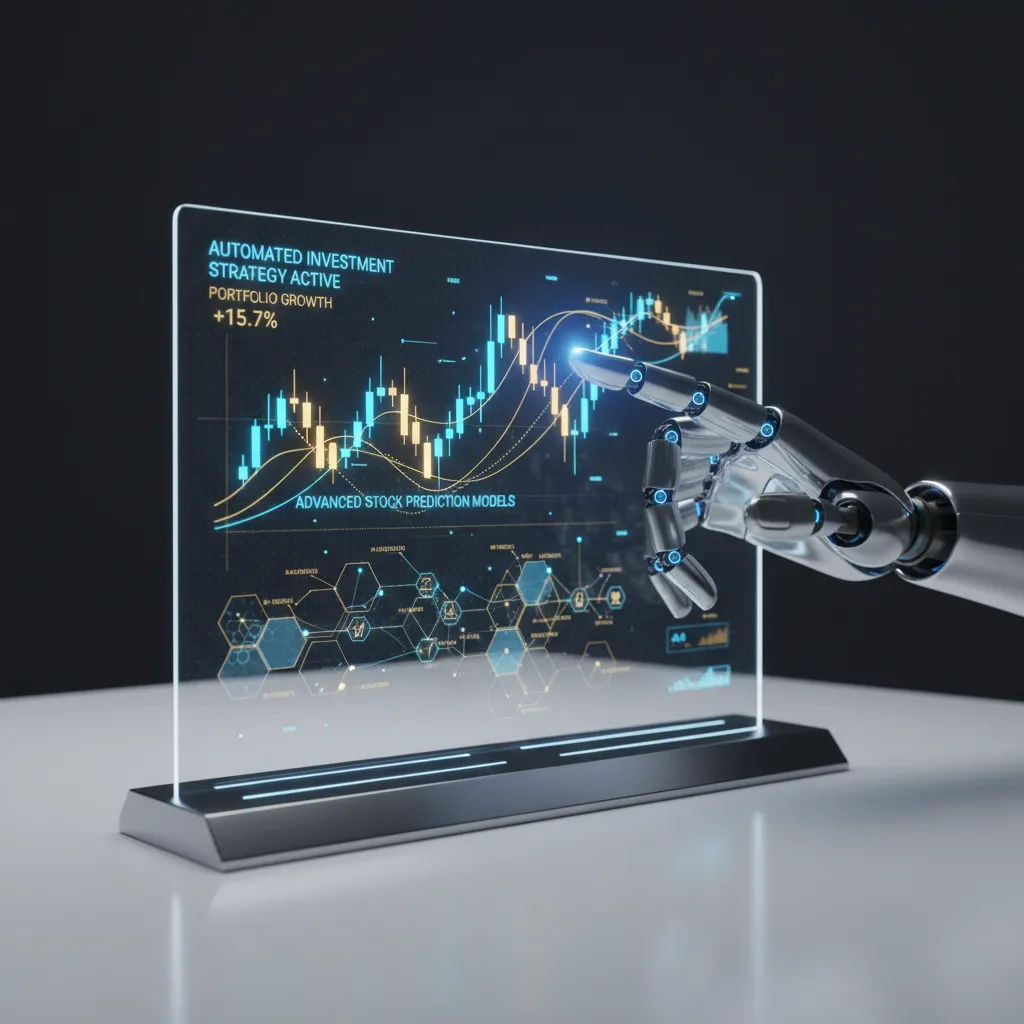
An AI driven trading bot is a software program that connects to a financial exchange and executes trades automatically on your behalf. These bots are the practical application of the strategies discussed above. They can operate 24/7, a crucial advantage in global markets like foreign exchange and cryptocurrency. AI crypto trading, in particular, has seen a massive proliferation of bots due to the market’s high volatility and continuous nature.
Choosing the Right Algorithmic Trading Software and Platforms
As interest grows, so does the number of algorithmic trading software and AI investment platforms available to retail investors. When evaluating options, consider:
- Data Quality: The platform must provide clean, accurate, and real time market data AI.
- Backtesting Engine: The ability to rigorously test your strategies on historical data is non-negotiable.
- Ease of Use: Some platforms are code-heavy, while others offer user-friendly visual strategy builders.
- Supported Markets: Ensure the platform connects to the exchanges and asset classes you want to trade.
- Transparency: For “black box” solutions, understand the underlying methodology and risks.
The Need for Speed: High Frequency Trading (HFT) and Low Latency
At the apex of the trading world is High Frequency Trading AI, where firms co-locate their servers in the same data centers as the stock exchanges. In this game of microseconds, low latency trading AI is paramount. The goal is to gain a speed advantage of a few millionths of a second to execute orders before competitors. AI is used here to make rapid-fire decisions and manage the immense operational complexity.

The Tangible Benefits and Inherent Risks of AI Trading
While the potential is enormous, it’s crucial to approach AI trading with a balanced perspective.
Major Algorithmic Trading Benefits
- Speed & Efficiency: AI can analyze data and execute trades at speeds no human can match.
- Emotionless Discipline: It removes fear, greed, and panic from trading decisions, sticking strictly to the strategy.
- Enhanced Accuracy: By processing more data, AI can make more informed and statistically sound decisions.
- Rigorous Backtesting: Strategies can be tested against years of historical data to validate their potential effectiveness.
- 24/7 Market Coverage: AI systems can monitor global markets around the clock without fatigue.
Navigating the Challenges: Risk, Regulation, and the Black Box Problem
- Overfitting: This is a major risk where a model learns the historical data too well, including its random noise, and fails to perform in live market conditions.
- Systemic Risk: A bug in a popular algorithm or an unforeseen event could trigger a cascade of automated sell orders, leading to a “flash crash.”
- The Black Box: The decisions made by complex deep learning models can be difficult for humans to understand. This lack of transparency is a major hurdle. To combat this, the field of Explainable AI finance (XAI) is emerging, aiming to create models that can articulate the reasoning behind their decisions.
- Data Snooping: Torturing the data until it confesses a pattern that isn’t actually there is a common pitfall. Robust AI risk management trading protocols are essential to prevent this.
Getting Started: Algorithmic Trading for Beginners
Venturing into AI trading requires a thoughtful, educated approach. It’s not a get-rich-quick scheme.
- Build Your Foundation: Before touching any code or platform, immerse yourself in the fundamentals of financial markets, statistics, and trading principles. Understand risk management above all else.
- Choose Your Path: Decide if you want to (a) use an existing AI investment platform, (b) build your own models using programming languages like Python with libraries like TensorFlow and Scikit-learn, or (c) use a visual strategy builder that requires no coding.
- Develop and Backtest: Start with a simple, logical strategy. Test it relentlessly on historical data. Analyze its performance during different market regimes (bull markets, bear markets, sideways markets).
- Paper Trade: Before risking real capital, deploy your strategy in a simulated environment with live market data. This is a critical step to see how it performs in real-time without financial risk.
- Start Small: Once you go live, begin with a very small amount of capital you are fully prepared to lose. Monitor the system closely and be prepared to intervene if it behaves unexpectedly.

Conclusion: The Dawn of a New Financial Era
AI algorithmic trading is more than just a technological trend; it’s a fundamental reshaping of the financial landscape. By combining the processing power of machines with the adaptive intelligence of AI, we are unlocking new frontiers in market prediction, risk management, and automated portfolio optimization. The journey from rigid algorithms to dynamic, learning systems marks the dawn of a new era of smart investment AI.
For both institutional and retail investors, the opportunities are immense. However, they must be approached with caution, education, and a deep respect for the risks involved. The future of trading AI is not about replacing human insight but augmenting it, allowing us to navigate the complexities of the market with more data, speed, and intelligence than ever before. As this technology becomes more accessible, it empowers individuals to take a more active and sophisticated role in their own AI wealth management.
Related: Streamline Your Day: How AI is Revolutionizing Daily Routines and Habits
Frequently Asked Questions (FAQs)
Q1. What is the difference between AI trading and algorithmic trading?
Algorithmic trading uses a fixed set of predefined rules (e.g., “if price > X, then buy”). AI trading is a more advanced subset where the system can learn from new data, identify complex patterns, and adapt its own rules over time without human intervention, making it more dynamic and predictive.
Q2. Can AI really predict the stock market?
AI cannot predict the stock market with 100% certainty, as markets are influenced by random events. However, AI market prediction models can identify statistical probabilities and patterns that are invisible to humans, giving them a significant edge in forecasting likely market movements and improving the odds of profitable trades.
Q3. Is AI trading profitable?
AI trading can be highly profitable, but it is not a guarantee. Profitability depends on the quality of the data, the sophistication of the strategy, robust backtesting, and effective risk management. Like any form of trading, it carries a significant risk of loss.
Q4. How can a beginner start with AI algorithmic trading?
A beginner should start with education—learning market fundamentals and basic statistics. The next step is to use a user-friendly AI investment platform that offers paper trading (a simulated account). This allows you to experiment with building and testing strategies using real market data without risking any actual money.
Q5. What programming language is best for AI trading?
Python is overwhelmingly the most popular language for machine learning finance and AI trading. This is due to its simplicity and extensive ecosystem of powerful libraries for data analysis (Pandas, NumPy), machine learning (Scikit-learn, TensorFlow, PyTorch), and connecting to broker APIs.
Q6. What are the main risks of using AI driven trading bots?
The primary risks include technical failures (bugs, connectivity issues), model risk (the strategy failing in live markets), and overfitting (the bot being too tuned to past data). There’s also systemic risk, where an unforeseen market event causes the bot to behave in unexpected and costly ways.
Q7. Do quantitative hedge funds use AI?
Yes, absolutely. The world’s top quantitative hedge funds are pioneers in using Quant trading AI. They employ teams of Ph.D.s in physics, mathematics, and computer science to build sophisticated deep learning trading and machine learning models that drive their entire investment process.