Unleash Your Productivity: The Rise of AI Agents for Daily Tasks

Introduction
The modern world runs on a relentless treadmill of tasks. Emails flood our inboxes, calendars fill up with meetings, and a never-ending stream of micro-decisions chips away at our focus and energy. We’re constantly juggling, scheduling, and organizing, often feeling like we’re managing the logistics of our lives rather than actually living them. What if you had a tireless, intelligent assistant working behind the scenes to handle it all? This isn’t science fiction anymore; it’s the reality being built by AI agents.
These are not just the simple voice assistants we’ve grown accustomed to. We’re entering the era of personal productivity AI—a new class of intelligent agents designed for proactive, autonomous daily task automation. These tools promise to do more than just answer questions; they aim to understand your goals and execute multi-step tasks across different applications to achieve them.
This comprehensive guide will explore the rise of intelligent agents and their transformative impact on our daily lives. We’ll demystify how AI agents work, showcase practical AI agent use cases that you can implement today, and look at the best AI productivity tools leading this revolution. Get ready to learn how to automate routine tasks and reclaim your most valuable resource: time.
What Exactly Are AI Agents? Beyond the Buzzwords
Before we dive into the practical applications, it’s crucial to understand what separates a true AI agent from a standard AI model or a virtual assistant like Siri or Alexa. While virtual assistants are reactive—waiting for a specific command to perform a single action—AI agents are proactive and autonomous.
Think of it this way:
- A virtual assistant is like a calculator. You tell it “8 times 52,” and it gives you “416.” It’s fast and accurate but requires a direct command for a single task.
- An AI agent is like a personal financial advisor. You tell it, “I want to save for a vacation to Italy next year.” The agent then analyzes your income, finds potential savings in your budget, researches flight and hotel deals, and presents you with a complete plan. It takes a high-level goal and breaks it down into a series of actions.
At their core, machine learning agents are defined by four key characteristics:
- Autonomy: They operate independently without constant human intervention. You provide the goal, and they figure out the steps.
- Proactivity: They can initiate actions to achieve their goals. An agent might notice an upcoming bill and remind you to pay it or even pay it for you if given permission.
- Goal-Orientation: They are designed to achieve specific objectives. Whether it’s booking a trip, managing your calendar, or organizing your files, their actions are purposeful.
- Adaptability: The most advanced agents can learn from their interactions and outcomes, continuously improving their performance and personalizing their assistance to your unique needs.
This new wave of technology, including advancements seen in systems like [Related: Apple Intelligence: A Complete Guide to iOS 18’s New AI Features], is pushing the boundaries of what a digital assistant can be.
The Core Mechanics: How AI Agents Understand and Execute Your Tasks
So, how does an AI agent go from a simple instruction like “Plan my weekend” to a fully booked itinerary? The process involves a sophisticated loop of perception, reasoning, and action, powered by Large Language Models (LLMs) and a suite of digital tools.
1. Perception: Understanding the Goal and Context
First, the agent takes in your request. This can be through text, voice, or even by observing your digital environment (like reading a new email). It uses Natural Language Processing (NLP) to understand not just the words but the underlying intent. It also gathers context from connected applications—your calendar, email, contacts, and even location data—to build a complete picture of the task.
2. Reasoning and Planning: Creating the Blueprint
This is where the agent’s “brain” kicks in. Using a powerful LLM, it breaks down your high-level goal into a sequence of smaller, logical steps.
- Goal: “Find a good Italian restaurant for dinner with Alex tomorrow night and book a table.”
- Agent’s Plan:
- Check my calendar for free slots tomorrow evening.
- Check Alex’s shared calendar (if available) to find a mutual time.
- Search for “Italian restaurants” in my area.
- Filter results based on high ratings (4 stars or more).
- Cross-reference with my past dining history to see if I have any favorites.
- Access the restaurant’s booking system via an API.
- Find an available table for two at the identified time.
- Make the reservation under my name.
- Add the event to my calendar and invite Alex.
- Send me a confirmation with the details.
This ability to strategize and create a multi-step plan is the essence of AI workflow automation.
3. Action: Executing the Plan in the Digital World
Once the plan is set, the agent uses Application Programming Interfaces (APIs) to interact with other software and services. APIs are the digital handshakes that allow different apps to talk to each other. The agent can use them to send emails, book appointments, make purchases, and control smart home devices, effectively acting as your digital proxy to achieve AI driven task completion.
Revolutionizing Your Daily Routine: Practical AI Agent Use Cases
The true power of AI for daily life is unlocked when you apply it to the mundane, repetitive tasks that consume your time and mental bandwidth. Here are some of the most impactful ways AI agents are changing the game.
Taming the Inbox: The AI Personal Assistant for Email
The email inbox is a notorious productivity black hole. An AI agent can transform it from a source of stress into a streamlined communication hub.

Imagine an agent that can:
- Prioritize and Summarize: It scans incoming emails, identifies which are urgent based on sender and content, and provides you with a one-sentence summary of each.
- Draft Replies: For common inquiries, the agent can draft context-aware responses that you can approve or edit with a single click.
- Manage Subscriptions: It can identify promotional emails and newsletters, summarizing the interesting ones and offering to unsubscribe from the rest.
- Extract Action Items: The agent reads through long email chains, pulls out key tasks and deadlines, and automatically adds them to your to-do list or calendar.
This level of AI task management frees you to focus on the messages that truly require your attention.
Mastering Your Schedule: AI Time Management and Planning
Scheduling is another area ripe for disruption. The back-and-forth of finding a meeting time is a classic time-waster for AI for busy professionals.

An AI scheduling agent can handle the entire process:
- Automated Booking: You can simply tell your agent, “Find a 45-minute slot for me, Jessica, and David to discuss the Q4 budget next week.” The agent will cross-reference everyone’s calendars and propose the best times.
- Intelligent Buffering: It learns your preferences, automatically adding buffer time before and after meetings so you’re not constantly rushing.
- Focus Time Protection: The agent can proactively block out “deep work” sessions on your calendar, protecting your most productive hours from interruptions. This is a key strategy for achieving peak performance, a concept explored in [Related: Deep Work Mastery: How to Unlock Focus and Boost Productivity in a Distracted World].
This is a prime example of how smart automation tools can deliver a significant boost to productivity AI.
The Connected Home: Smart Living and AI in Home Automation
Your home can become a responsive, intelligent environment with the help of an AI agent. By connecting to your smart devices, it moves beyond simple voice commands to create a truly automated living experience.

Consider an agent that:
- Learns Your Routines: It observes your habits and creates automated “scenes.” For example, a “Good Morning” scene could gradually raise the lights, start the coffee maker, adjust the thermostat, and play your favorite podcast.
- Manages Energy Consumption: The agent can optimize your smart thermostat, lighting, and appliances to reduce energy usage without sacrificing comfort, lowering your utility bills.
- Enhances Security: It can manage smart locks, cameras, and sensors, sending you intelligent alerts only when something is truly out of the ordinary, like a package being delivered or an unfamiliar car in the driveway.
This level of smart home AI integration is at the heart of the vision for AI for smart living, a topic we delve into deeper in our guide on [Related: The Rise of AI Smart Homes: Revolutionizing Efficiency, Security, and Comfort in 2024].
From To-Do Lists to “Done”: AI for Personal Organization
An AI agent acts as the ultimate tool for AI for personal organization, capable of managing complex personal logistics and research tasks that would normally take hours.
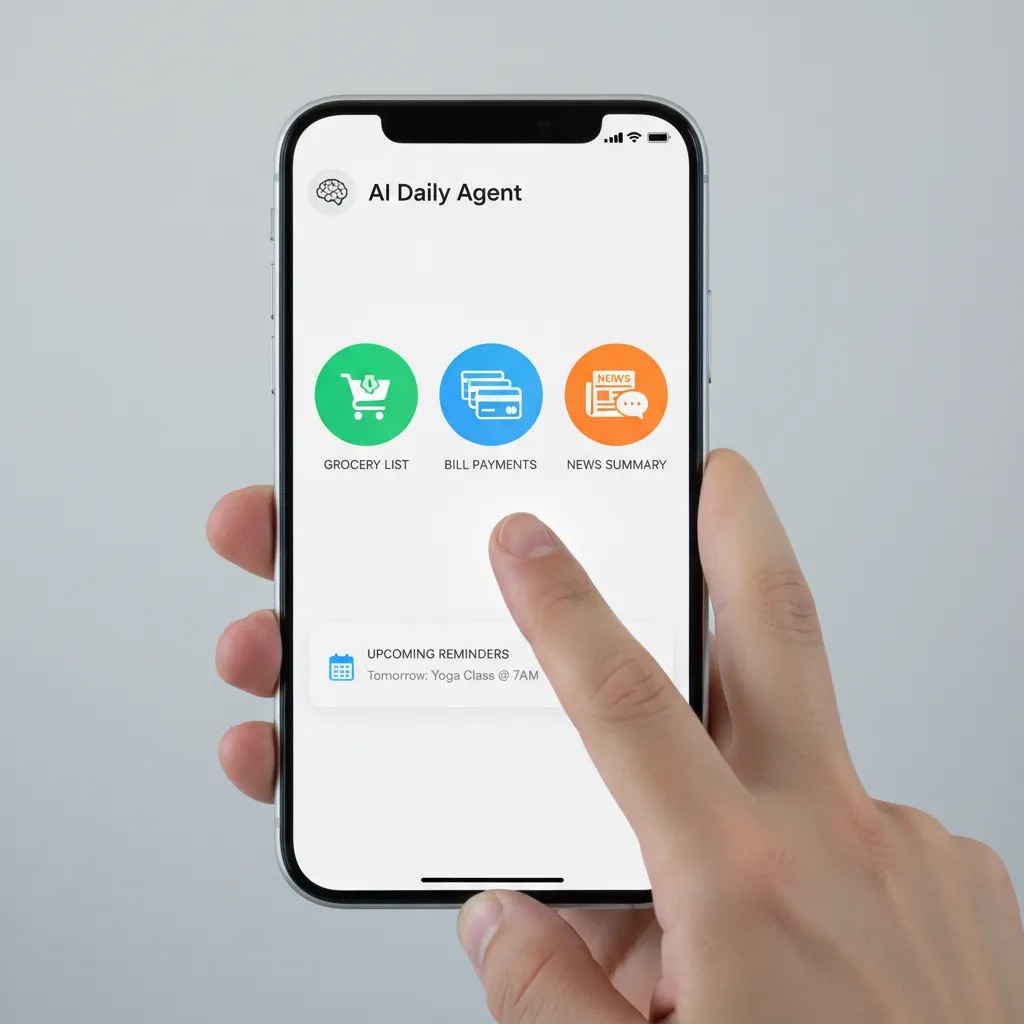
Here are just a few possibilities:
- Travel Planning: Give it a simple prompt like, “Plan a 3-day weekend trip to San Diego for two next month on a budget of $1,000.” The agent can research flights, find well-reviewed hotels, suggest an itinerary, and present you with a complete package.
- Research Assistant: Ask it to “Research the main competitors for a new coffee shop idea, summarize their strengths and weaknesses, and find data on local coffee consumption trends.”
- Health and Fitness: An agent can help you track workouts, suggest healthy recipes based on ingredients you have, and schedule reminders for medications or appointments. As AI becomes more integrated with wellness, its potential to promote a calmer mind is immense, something we explore in [Related: How AI Can Help You Cultivate a Calmer Mind].
The Toolbox: Best AI Productivity Tools Leading the Charge
The ecosystem of AI agents is exploding. While a single, all-powerful agent from a movie like Her is still on the horizon, many specialized and powerful tools are available today.
General Purpose & Web-Native Agents
These tools aim to act as a layer on top of your existing applications, primarily working through web browsers to automate tasks.
- MultiOn: Often called the “world’s first AI agent,” MultiOn can take natural language commands and execute them on the web. You can ask it to order your groceries, book a flight, or fill out complex forms on your behalf.
- Adept: This company is building a foundational model that understands how to use software tools. Their goal is to create an “over-the-shoulder” AI partner that can perform tasks in any application just by watching you do it once.
Workflow Automation Platforms (AI-Supercharged)
Traditional automation platforms are integrating advanced AI to become more powerful and accessible.
- Zapier: With its new AI features, you can now describe a workflow in plain English, and Zapier will build the multi-step “Zap” for you, connecting thousands of apps without you needing to understand the technical details.
- Make: Similar to Zapier, Make’s visual workflow builder is becoming more intelligent, allowing for more complex conditional logic and AI-powered data processing within your automations.
Specialized Assistants
These tools excel at specific, high-value tasks.
- Fireflies.ai: An AI meeting assistant that joins your calls, transcribes them, summarizes key action items, and makes the entire conversation searchable. It’s a game-changer for anyone who spends a lot of time in meetings.
- Clockwise: A smart calendar assistant that automatically optimizes your team’s schedule to open up more blocks of uninterrupted focus time.
The Road Ahead: The Future of Work and Life with AI Agents
The current wave of AI efficiency tools is just the beginning. The future of productivity and daily life will be profoundly shaped by the evolution of these intelligent partners.
We’re moving toward a world of hyper-personalization, where your agent will have a deep, nuanced understanding of your goals, preferences, and communication style. It will anticipate your needs before you even articulate them. Furthermore, we will see the rise of multi-agent systems, where specialized agents (a travel agent, a finance agent, a scheduling agent) collaborate seamlessly to handle extremely complex requests.
However, this future is not without its challenges. Questions of data privacy, security, and algorithmic bias are paramount. As we delegate more of our lives to these systems, ensuring transparency and human oversight will be critical. The ethical implications, particularly as AI touches sensitive areas like healthcare, require careful consideration, a theme we explore in [Related: The Ethical Frontier: Navigating AI in Healthcare for Equity and Accessibility].
Conclusion
AI agents represent a paradigm shift in how we interact with technology. They are evolving from simple tools into true digital partners, designed to handle the friction of modern life so we can focus on what truly matters. By automating routine tasks, managing complex schedules, and streamlining our digital workflows, these next-gen personal AI systems are unlocking unprecedented levels of productivity and creating more space for creativity, strategic thinking, and personal well-being.
The journey has just begun, but the message is clear: the future of work and life is one where humans and intelligent agents collaborate. The question is no longer if you should adopt these tools, but how you can start leveraging them to build a more efficient, organized, and intentional life.
Ready to start your automation journey? Pick one repetitive task that drains your energy this week, explore one of the tools mentioned, and take the first step toward reclaiming your time.
Frequently Asked Questions (FAQs)
Q1. What is an example of an AI agent in daily life?
A great example is an AI-powered travel agent. You can give it a high-level goal like “Plan a budget-friendly weekend trip to the mountains for me,” and it will autonomously research flights, compare accommodations, check weather forecasts, and suggest an itinerary, handling all the steps a human travel agent would.
Q2. What is the difference between an AI and an AI agent?
“AI” is a broad field of computer science focused on creating intelligent machines. An “AI agent” is a specific application of AI. The key difference is that an agent is a system that perceives its environment and takes autonomous actions to achieve specific goals. A simple AI model might classify an image, but an AI agent would use that classification to take a follow-up action, like sorting photos into albums.
Q3. Is Siri or Alexa considered an AI agent?
Siri and Alexa are best described as “virtual assistants.” While they use AI, they are mostly reactive, waiting for a direct command to perform a single, predefined task (e.g., “Set a timer”). True AI agents are more proactive and can handle complex, multi-step goals that require them to interact with multiple applications autonomously. However, these platforms are rapidly evolving to incorporate more agent-like capabilities.
Q4. How can AI help me organize my life?
AI can organize your life through AI for personal organization tools that automate key tasks. This includes managing your email by prioritizing and summarizing messages, optimizing your schedule by finding meeting times and protecting focus time, creating and managing to-do lists from conversations, and even planning complex events or trips.
Q5. What are the risks of using AI agents for personal tasks?
The primary risks involve data privacy and security. Giving an agent access to your personal data (emails, calendars, contacts) requires a high level of trust in the company’s security measures. There is also a risk of over-reliance, which could diminish critical thinking skills, and the potential for algorithmic bias to influence the agent’s decisions.
Q6. Can AI agents learn and adapt over time?
Yes, one of the core features of advanced AI agents is their ability to learn. They can adapt based on your feedback (e.g., you telling it a summary was unhelpful) and by observing your actions and preferences. Over time, a good agent becomes more personalized and efficient as it better understands your unique needs and workflows.